
Harlow Dog Track Distances: Circuit Length, Race Trips and Bend Geometry
 Available in US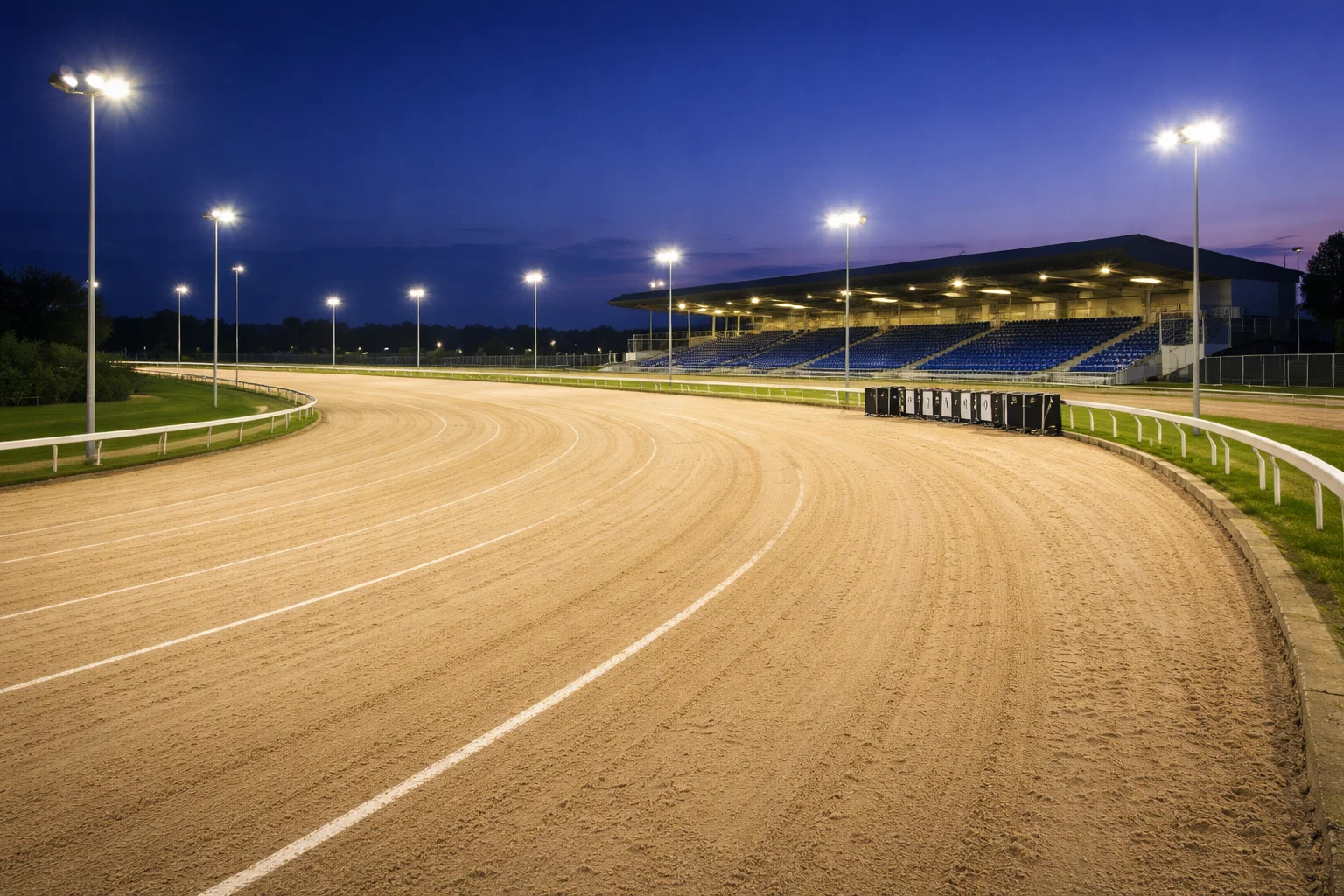
Every time I explain Harlow’s track layout to someone familiar with horse racing, they are surprised by how small the circuit is. The 334-metre oval at Harlow Stadium is not a sprawling arena – it is a compact, purposeful course where geometry matters more than raw speed and where every metre of the layout shapes the racing in measurable ways. The distances available, the bend radii, the position of the traps relative to the first turn – all of these factors feed directly into form analysis, and ignoring them means you are analysing Harlow results with half the picture. This piece maps the circuit and explains why its dimensions produce the racing patterns you see in the form book.
See also: harlow greyhound results — Harlow greyhound racing insights.
The 334-Metre Circuit: Dimensions and Bend Radii
Harlow Stadium opened in 1995 with a sand-based oval measuring 334 metres around the inside rail. That circumference places it toward the smaller end of the UK greyhound track spectrum – Romford, by comparison, is a 365-metre circuit, and Towcester (before its closure and subsequent reopening saga) was a significantly larger 469-metre track. The size difference is not trivial: a smaller circuit means tighter bends, shorter straights, and a different set of biomechanical demands on every dog that races.
The bends at Harlow are the defining feature of the track. On a 334-metre oval, the turn radii are smaller than at larger circuits, which means dogs experience greater lateral force through each bend. That force loads the inside legs, compresses the stride, and penalises dogs that carry their weight on the outside of the turn. A dog that handles tight bends efficiently – one that leans into the turn, maintains speed through the apex, and accelerates out of the exit – has a structural advantage at Harlow that it would not enjoy at a more spacious track.
The two straights at Harlow are relatively short compared to wider circuits. The home straight – where dogs sprint to the finish – is long enough for a positional change of one or two lengths but rarely enough for a dog in fourth or fifth to overhaul the leaders. This compression rewards front-running styles and penalises deep closers, which is why early pace and clean trapping dominate the form narrative at Harlow more than at tracks with longer straights where closing dogs have more ground to make up.
Available Race Trips and Their Characteristics
Harlow offers three standard race distances: 238 metres, 415 metres and 592 metres. Each uses a different starting position on the circuit and covers a different number of bends, creating three distinct racing experiences that test different attributes.
The 238-metre sprint starts on the back straight and finishes on the home straight after a single bend. It is the shortest trip on the card and the most influenced by trap draw and early pace. A dog drawn in Trap 1 has the shortest route through the bend; a dog in Trap 6 covers more ground on a wider arc. Over 238 metres there is no second bend to correct a poor first-bend position, and the race is often decided before the field reaches the straight. Sprint results at Harlow are the most predictable by trap draw and the least predictable by closing ability – if a dog does not lead or sit second at the bend, its chances are slim.
The 415-metre standard distance is the workhorse of the Harlow card. It covers one full lap of the circuit plus additional run-in, taking the field through four bends. The 415 is where the grading system operates most actively, and the majority of races on any Harlow card are at this distance. The four-bend layout tests both early pace and sustained speed: a dog needs to break well enough to avoid first-bend traffic and then hold its effort through three more turns and a finishing straight. The balance of pace and stamina required at 415 metres is why form at this distance is the most reliable and the most analytically rich.
The 592-metre stayers’ trip covers nearly two full laps – eight bends in total. It is the least frequently run distance at Harlow and the one most influenced by stamina rather than speed. Trap draw matters less at 592 metres because the extended race gives dogs in poor early positions time and space to recover. The dogs that win over 592 metres at Harlow are specialists: they manage their pace through the first lap, conserve energy through the middle bends, and produce a closing effort that front-runners cannot match. The 592 rewards a different running style to the 238 or 415, and dogs that excel at one distance do not necessarily handle another.
How Circuit Length Shapes Pace Patterns
The 334-metre circumference creates a racing rhythm that is different from what you will find at larger tracks. Because the bends come quickly – a dog at 415 metres encounters a bend roughly every 80-85 metres of running – there is less time on the straights to build top speed or recover from a checking incident. The pace at Harlow is sustained rather than peaked: dogs run at a high but not maximal effort through most of the race, with short bursts of acceleration on the straights and slight deceleration through each bend.
Check Harlow 592m results.
This rhythm favours dogs with what form readers call “tactical pace” – the ability to run at a consistent speed without burning out. At larger tracks, dogs can afford to coast on longer straights and then sprint through the bends, but Harlow’s compact layout does not allow that luxury. A dog that needs a long straight to hit top speed will feel cramped at Harlow, while one that accelerates quickly and holds pace through turns will thrive.
Trap 6’s 21% win rate at Harlow – well above the 16.67% theoretical baseline – is partly a product of the circuit geometry. The outside trap at Harlow does not have as far to travel to reach the first bend as it would at a larger track, because the straights are shorter. A fast-breaking Trap 6 runner can cross to the front before the first turn arrives, and from there the tight bends actually work in its favour – leading through a tight bend is easier than chasing through one, because the leader dictates the line and the chasing pack must adjust. This is a Harlow-specific dynamic that does not transfer to wider circuits.
For punters building a form database, the practical takeaway is to treat Harlow as its own ecosystem. Times, trap biases and pace patterns from Harlow do not translate directly to other tracks, and dogs moving to or from Harlow need an adjustment period. A dog with outstanding form at a wider, faster circuit may take two or three runs at Harlow to adapt to the tighter geometry, and its early results should not be taken at face value until the adaptation is complete.
