
Harlow 592 m Results: Stayers’ Data and Stamina Indicators
 Available in US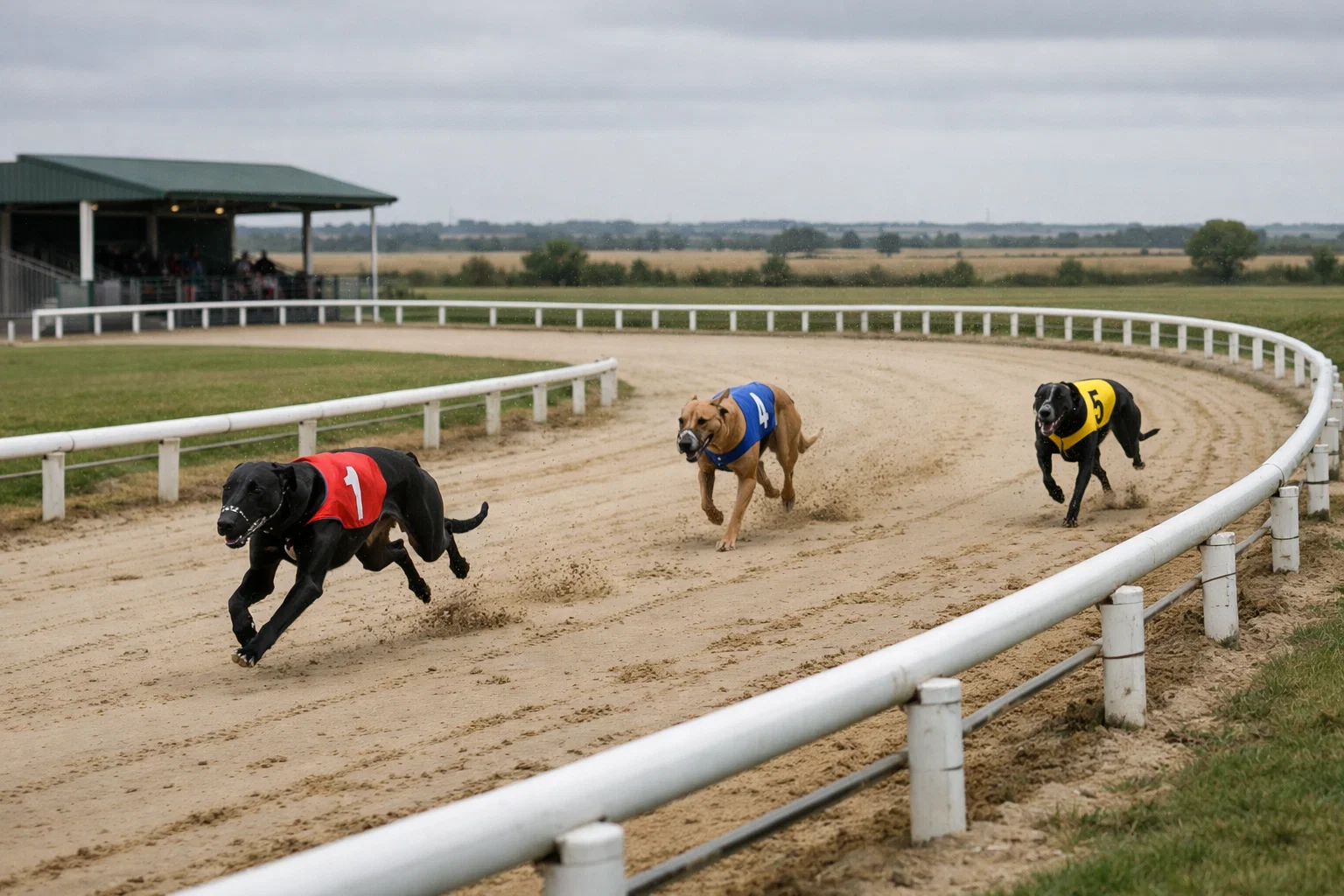
Stayers’ races are the most misread events on any Harlow card. I say that from experience – years ago I used to treat 592-metre results as longer versions of the 415 and lost money assuming that the same form angles would transfer. They do not. The 592-metre trip at Harlow’s compact 334-metre oval involves nearly two full laps, eight bends, and a race rhythm that rewards stamina, racing intelligence and the ability to settle into a sustainable pace rather than raw early speed. If you have been wondering why a dog with blazing 415-metre form sometimes flops over the extended trip, the answer is usually buried in the biomechanics of multiple bends on a tight circuit.
Harlow runs fewer 592-metre races than middle-distance events, which means the form sample for any individual dog at this distance is often thin. That scarcity makes each result more informative – and more easy to misinterpret. This piece breaks down what the stayers’ trip demands, how trap draw functions differently over two laps, and which form lines actually predict success at 592 metres.
See also: harlow greyhound results — the Harlow greyhound racing guide.
The 592 m Trip at Harlow: Bends, Pace and Stamina
Picture the layout. A 592-metre race at Harlow starts on the back straight, takes the field through a full first lap of four bends, then continues around a second set of four bends before hitting the home straight for the finish. That is eight bends in total – double the number a 415-metre runner faces and eight times the bend count in a 238-metre sprint. On Harlow’s 334-metre circuit, each bend has a tighter radius than at most UK tracks, and negotiating eight of them demands a specific physical skill: the ability to hold a racing line under fatigue.
Pace management is the defining characteristic of a successful stayer at Harlow. Richard Brankley, SIS’s Head of Greyhound Operations, has spoken about the logistical importance of different track configurations in UK racing, and that importance is nowhere more obvious than at the stayers’ distance. A dog that goes flat out from box to first bend at 592 metres will burn energy reserves that it needs for the second lap. The best stayers run the first circuit at a controlled tempo, save their acceleration for the closing bends, and finish with a surge rather than a fade. You can see this in the sectional splits when they are available – a genuine stayer’s first-lap sectional is notably slower than its second-lap equivalent, while a failed front-runner shows the opposite pattern.
The tight bends also amplify the physical toll. Every time a greyhound negotiates a bend, it loads its inside legs with lateral force. At 238 metres that happens once. At 415, four times. At 592, eight times. The cumulative stress on joints and muscles over eight bends at Harlow’s radius is considerable, and it filters out dogs that lack the structural soundness to sustain effort through repeated direction changes. This is why a dog’s physical condition – reflected partly in weight trends and partly in the trainer’s recent record – matters more at 592 metres than at shorter trips.
Trap Draw Relevance Over Two Laps
Here is a stat that surprises most people: the correlation between trap draw and win rate weakens significantly at the stayers’ distance compared to sprints or middle-distance races. The theoretical baseline is the same – 16.67% per trap in a six-runner field – but over 592 metres the variation around that baseline narrows. Inside traps still win slightly more often, but the margin is smaller because the second lap provides ample time for wide runners to find position.
The reason is straightforward. At 238 metres, a positional disadvantage at the first bend is terminal. At 415, it is damaging but recoverable. At 592, the dog has four more bends after the first turn to improve position, and a single poor bend out of eight has a diluted impact on the overall result. I have tracked hundreds of 592-metre races at Harlow and the pattern is consistent: dogs that are fourth or fifth at the first bend win at 592 metres roughly twice as often as they win at 238. Trap draw matters less because race duration matters more.
That said, trap draw is not irrelevant. A dog drawn in Trap 1 that breaks cleanly still saves ground through every bend, and over eight bends those savings add up. The edge is just smaller in percentage terms. Where trap draw does matter at 592 metres is in the pace scenario: if two confirmed front-runners are drawn adjacent in Traps 1 and 2, they may battle for the lead through the first lap and burn each other out, opening the door for a patient closer drawn wider. Reading the pace map is more valuable than reading the trap draw at the stayers’ trip.
Form Lines That Predict Stayers’ Success
When I assess a dog for a 592-metre race at Harlow, I look at three things before anything else: its closing sectional at 415 metres, its weight stability, and its recent racing frequency. Each of these tells a different part of the stamina story.
Closing sectionals at 415 metres are the single best predictor of 592-metre ability. A dog that consistently finishes its 415-metre races with a strong closing split – maintaining pace or accelerating through the final two bends – is demonstrating the aerobic fitness needed to sustain effort over the longer trip. The reverse is equally telling: a dog that posts fast early sectionals at 415 but fades in the closing stages is a confirmed front-runner whose stamina ceiling has been reached. Stepping that dog up to 592 metres is asking it to run further than its cardiovascular system wants to go.
Explore Harlow 415m results.
Weight stability over three or four runs signals physical wellbeing. A stayer carrying extra weight tires faster through the bends, and a dog that has lost weight sharply might lack the energy reserves for a two-lap effort. I look for fluctuations of less than half a kilogram across consecutive racecards. Anything beyond that range warrants investigation – a sudden weight drop before a 592-metre debut might indicate the trainer is trying to lighten the dog for stamina purposes, or it might signal a health issue that will undermine performance.
Racing frequency matters because fitness for 592 metres is not the same as fitness for 415. A dog that has raced every five days over 415 metres is match-fit but not necessarily endurance-fit. The ideal form line for a stayer is a dog that has had a recent 592-metre run – or at least a strong trial over an extended distance – within the past two to three weeks. Dogs stepping up to 592 metres for the first time on a card are an unknown quantity, and while some handle the distance naturally, others discover that the extra lap exposes limitations that shorter trips concealed. In the UK, 18 GBGB-licensed stadiums are currently operating, and each track’s distance offerings shape which dogs are trained for staying trips – Harlow’s 592-metre races tend to attract a specialist pool that trainers know can handle the distance.
Finally, running style matters more at 592 metres than anywhere else on the card. A greyhound that races prominently but not aggressively – one that sits second or third through the first lap and gradually moves to the front through the closing bends – is the archetype of a successful Harlow stayer. This running style, which I call “creeping,” shows up clearly in the running comments: look for sequences like “2nd, 2nd, Led 6th” or “3rd, 3rd, Chl 7th, Led Run In.” Dogs with this profile handle the pacing demands of the 592-metre trip better than habitual leaders or deep closers, and they are the form line I trust most when the stayers’ race comes up on the card.
