
Greyhound Sectional Times: Split Data and Pace Analysis for Harlow Races
 Available in US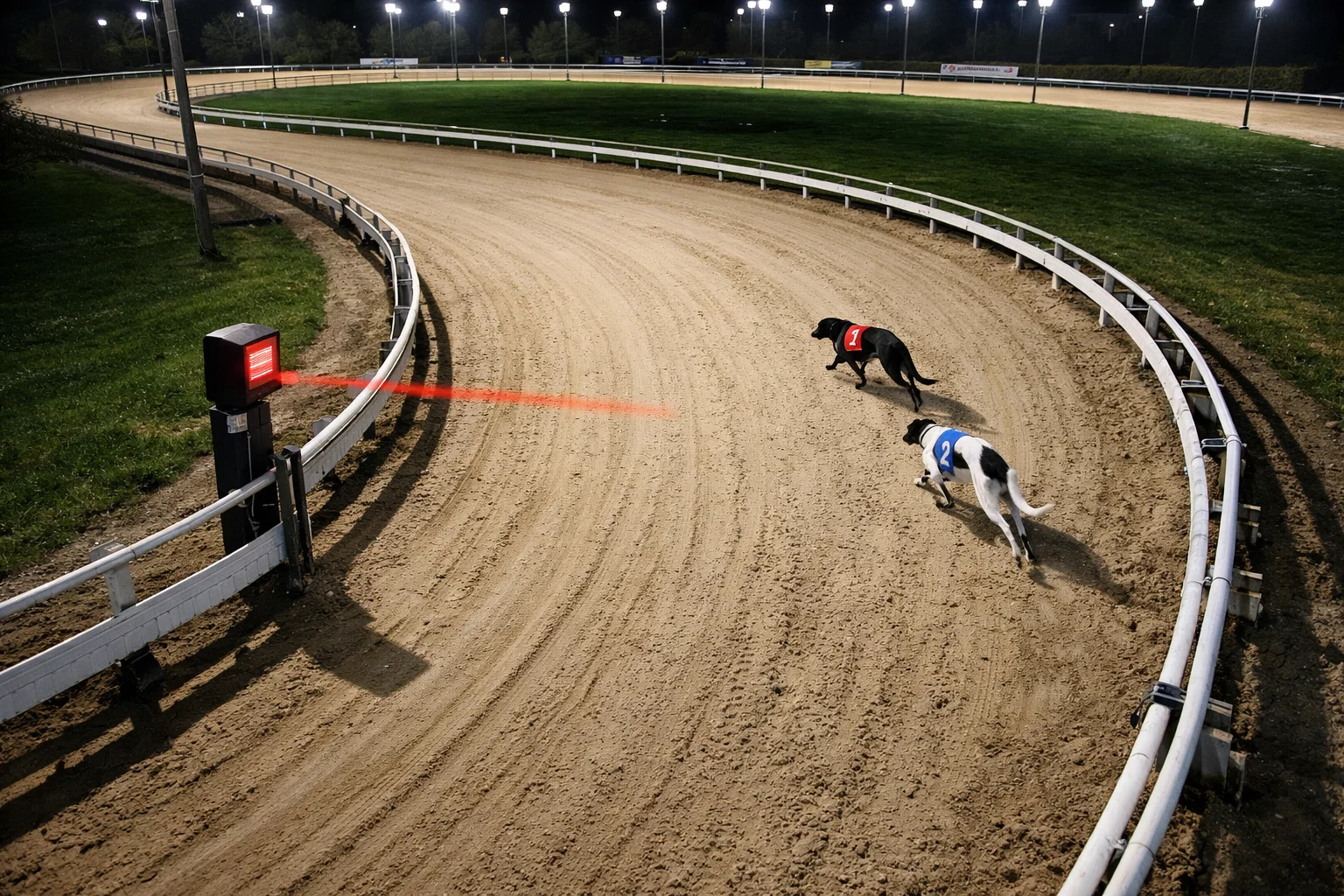
Sectional times are the X-ray of greyhound racing form. A finishing time tells you how fast the dog ran from start to finish, but sectionals tell you how it ran – whether it burned its energy in the first two bends and faded, or conserved pace through the opening circuit and accelerated home. I started recording my own rough sectionals at Harlow years ago with a handheld stopwatch, clicking at the first bend and again at the line, and even that crude data transformed the way I read form. The gap between a dog’s first-bend split and its closing split is the most underused piece of information in greyhound betting, and this piece explains how to find it, read it and use it.
See also: harlow greyhound results — your source for Harlow greyhound info.
How Sectional Timing Works at Greyhound Tracks
Sectional timing divides a race into segments – typically defined by the bends – and records the time for each segment independently. At its most basic, a 415-metre race at Harlow can be split into two sections: the time from the traps to the first timing beam (usually positioned at or near the first bend) and the time from that beam to the finish line. More sophisticated systems break the race into additional segments, measuring each bend and each straight separately.
The technology behind sectional timing varies. Top-tier stadiums use electronic timing beams – infrared or laser sensors positioned at specific points around the circuit that trigger automatically as the leading dog passes. Harlow’s 334-metre circuit, which has hosted racing since its 1995 opening, has evolved its timing infrastructure over the years, and the availability of detailed sectional data depends on the meeting type and the broadcast arrangement.
BAGS meetings at Harlow, which are broadcast through SIS to bookmaker platforms, typically include at least a first-bend sectional for each runner. This first-bend split is the most analytically valuable single number beyond the finishing time, because it quantifies how a dog began the race – whether it was fast, moderate or slow to the first turn. Some data providers augment the official figures with additional sectional points derived from video analysis, adding mid-race and closing splits to the raw GBGB timing data.
The going allowance applies to sectional times just as it applies to finishing times, though with a proportional adjustment. A going allowance of +20 over a full 415-metre race translates to roughly +8 to +10 for the first sectional and +10 to +12 for the closing sectional, depending on the proportion of the race covered by each segment. The exact split depends on the track geometry, but the principle is straightforward: the same surface conditions that slow the overall time also slow each individual section.
Early Pace vs Late Pace: Reading the Splits
GBGB’s commercial director Mark Moisley has acknowledged that revenue from bookmakers is declining year-on-year, and the competitive pressure on the industry means tracks need to provide better data to engage sophisticated punters. Sectional times are part of that equation, and knowing how to read them is increasingly important as the data becomes more widely available.
A fast first sectional relative to the closing sectional identifies a front-runner. This dog breaks sharply, leads to the first bend, and spends its energy early. If its closing split is significantly slower than its opening split, the dog is a confirmed early-pace runner whose form is vulnerable when the pace is strong – when other dogs also want to lead, the first-bend battle drains energy and the closing stages become a test of stamina rather than speed.
A slow first sectional paired with a fast closing sectional identifies a closer. This dog breaks behind the field, races in the second half of the pack through the opening circuit, and accelerates through the closing bends. Closers are the form analyst’s favourite type at longer distances, because their finishing speed is often obscured by poor finishing positions – a dog that closes from fifth to third in the final two bends might have posted the fastest closing split in the race, even though it only finished third overall.
An even split – roughly equal first and closing sectionals – identifies a dog that distributes its pace uniformly. These dogs are rare and valuable, because even pacing is the most efficient way to run any fixed-distance race. A dog with balanced sectionals at 415 metres is typically running within its aerobic capacity and may have scope to improve over a longer trip where its pacing advantage translates into a stamina edge.
The most dangerous form trap is a dog with a fast first sectional and a fast finishing time – but the fast finishing time is a product of unchallenged leading rather than genuine closing pace. If you only look at the finishing time, this dog appears fast. If you look at the sectionals, you see that it built its time entirely in the opening stages and merely maintained pace to the line. The moment this dog faces a rival with matching early speed, its closing sectional will blow out because it cannot sustain the opening effort under pressure. Sectionals expose this pattern; finishing times do not.
Where to Source Harlow Sectional Data
Accessing sectional data for Harlow meetings requires knowing where to look, because it is not as uniformly published as finishing times and running comments. The primary sources are SIS broadcasts, which display first-bend sectionals for televised races; specialist data providers that compile sectional databases from timing systems and video analysis; and GBGB’s own records, which include timing data for all races at licensed tracks.
Learn about greyhound calculated time.
Harlow’s first televised meeting on Sky Sports was in 2011, and the broadcast expanded the availability of timing data significantly. SIS coverage now includes sectional information as part of its standard race data feed, meaning that bookmaker platforms displaying Harlow results will often include the first-bend split alongside the finishing time. The depth of sectional detail varies by platform – some show only the leading dog’s sectional, while others provide splits for the first three or four runners.
For punters who want comprehensive sectional data, third-party providers are the best option. These services compile timing data across multiple meetings, build pace profiles for individual dogs, and make the data available through subscription platforms or race-day reports. The cost is modest relative to the analytical advantage, and for anyone serious about Harlow form study, access to sectional databases is a worthwhile investment.
If formal sectional data is unavailable for a specific race, the running comments offer a crude substitute. A dog described as “QAw, Led, Led, Led, Won” has a confirmed fast first sectional – it led from the start and was never headed. A dog described as “SAw, 6th, 5th, Chl, 2nd” has a confirmed slow first split and a fast closing split. Running comments are not as precise as timed sectionals, but they confirm the pace profile in qualitative terms, and for races where formal sectional data is not published, they are the next best thing.
