
Greyhound Calculated Time Explained: Going Allowance and Adjusted Results at Harlow
 Available in US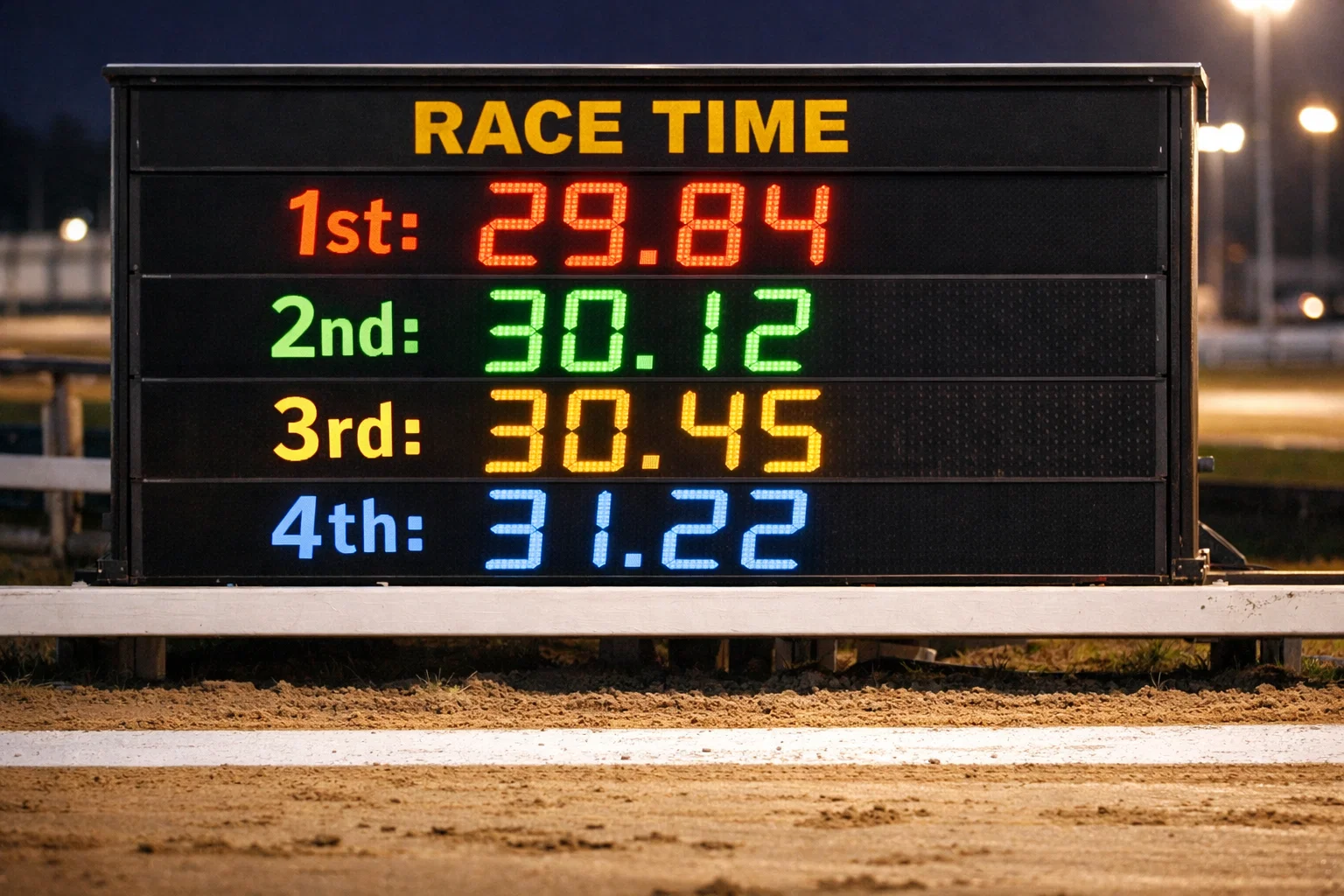
Raw time lies. Not deliberately, but consistently. A greyhound clocking 26.45 seconds over 415 metres at Harlow on a rain-soaked Monday evening is not running the same race as one clocking 26.45 on a dry, fast Friday surface – even though the stopwatch says they are identical. Calculated time exists to strip out that distortion, and it is the single most important number on any Harlow racecard for anyone who takes form analysis seriously. Yet I still meet experienced punters who compare raw times across meetings and wonder why their selections keep losing. This piece explains the mechanism, the maths, and why Harlow’s 334-metre circuit produces time ranges that differ from what you will see at other UK tracks.
See also: harlow greyhound results — everything about Harlow greyhounds.
Raw Time vs Calculated Time
Raw time is the stopwatch figure – the actual elapsed time from traps opening to the first dog crossing the finish line, measured in seconds and hundredths of a second. It is the number that appears in the live commentary and on the electronic board at the track. Raw time is accurate as a record of what happened in that specific race on that specific day, but it is useless for comparing races run on different days, in different weather, or on different going.
Calculated time adjusts the raw time by removing the effect of the track surface. On Harlow’s 334-metre circuit, the going allowance is determined before each meeting by timing a trial run over the standard distance and comparing it to a benchmark time for perfect conditions. The difference between the trial and the benchmark becomes the going allowance for that meeting, expressed in hundredths of a second. The calculated time for each race is then: raw time minus going allowance.
A quick example using Harlow numbers. Suppose the going allowance for a Monday evening meeting is +15, meaning the track is running 15 hundredths of a second slower than standard. A dog that wins a 415-metre race in a raw time of 26.55 has a calculated time of 26.55 – 0.15 = 26.40. On a faster surface with a going allowance of -5, a raw time of 26.35 produces a calculated time of 26.35 – (-0.05) = 26.40. Both dogs have identical calculated times, meaning they ran equivalent performances despite different raw figures. That equivalence is invisible without the adjustment.
The going allowance is not a subjective assessment. It is measured empirically at each meeting using a standard trial procedure, and it applies uniformly to every race on the card. This objectivity is what makes calculated time trustworthy – it is not a pundit’s opinion but a mathematical correction based on physical measurement of the track surface.
How Going Allowance Is Determined
Before each Harlow meeting, the track surface is assessed by timing a standard trial run. The trial dog – usually a consistent, reliable runner whose normal pace is well established – covers the standard 415-metre distance, and its time is compared to its established benchmark. The difference between the trial time and the benchmark becomes the going allowance.
If the trial dog runs 0.20 slower than its benchmark, the going allowance is +20, meaning the track is slow by 20 hundredths. If it runs 0.10 faster than benchmark, the going allowance is -10, meaning the track is fast. A going allowance of 0 (or “level”) means the track is running at standard pace, and raw times and calculated times are identical for that meeting.
Weather is the dominant factor driving going allowance at Harlow. Rain softens the track surface and slows times. Dry, warm conditions harden the surface and speed times up. Wind can also play a role – a headwind on the home straight adds time, while a tailwind subtracts it – but the going allowance captures these effects in aggregate rather than isolating them individually. The result is a single number that adjusts for all surface and atmospheric conditions at once.
Going allowance can change between the morning and evening sessions on the same day. If a dry morning is followed by afternoon rain, the PM going allowance will be higher (slower) than the AM figure. I always check the going allowance for the specific session rather than assuming it is constant across the day – an assumption that catches out punters who compare morning form to evening form without the adjustment.
One nuance: the going allowance is a track-wide figure, but the surface does not wear uniformly. The bends absorb more punishment than the straights, and the rail takes more traffic than the outside line. By the later races on a card, the inside running line may be slightly slower than the going allowance suggests, while the outside line remains closer to the published figure. This effect is small but measurable, and it is one reason why inside-drawn dogs can lose a fractional edge in the last two or three races of a long card.
Typical Calculated Time Ranges at Harlow by Distance
Every track produces its own time ranges because circuit geometry, surface material and altitude all affect pace. Harlow’s 334-metre circuit is tighter than most UK tracks, which means more time is spent negotiating bends and less time sprinting on the straights. The result is that Harlow’s calculated times for a given distance are slightly slower than those at larger, faster circuits – and comparing Harlow times directly to times from Romford, Towcester or Nottingham is misleading without adjusting for circuit differences.
Learn about greyhound sectional times.
Over 238 metres, strong Harlow calculated times fall below 14.80 seconds. The top-grade sprinters produce figures in the 14.40-14.60 range, while mid-grade company runs between 14.80 and 15.10. Anything above 15.20 usually indicates a slow break or in-running trouble rather than a lack of ability at the distance.
Over 415 metres – Harlow’s bread-and-butter distance – the calculated time range for graded races spans roughly 25.80 to 27.00. A1-grade races typically produce winners in the 25.80-26.10 band. Mid-grade races (A4 to A6) cluster around 26.20-26.60. Lower grades run from 26.60 upward. A calculated time below 26.00 over 415 metres at Harlow is genuinely quick and marks the dog as a potential higher-grade performer.
Over 592 metres, the ranges stretch further because the longer distance amplifies small pace differences. Strong stayer performances come in below 38.50 calculated, while mid-grade stayers run in the 38.50-39.50 range. The 592-metre distance produces the widest spread of times because stamina – a less predictable attribute than raw speed – plays the dominant role.
These ranges are Harlow-specific and should not be exported to other tracks. A dog that records 26.20 at Harlow is not directly comparable to one that records 26.20 at Romford, because the circuits are different sizes and the bend geometry affects how speed translates into time. If you follow dogs that race at multiple tracks – some trainers move dogs between Harlow and Romford, for example – convert times through track-specific benchmarks rather than comparing raw or even calculated figures head-to-head.
