
Graded vs Open Greyhound Races: How They Differ and Why It Matters at Harlow
 Available in US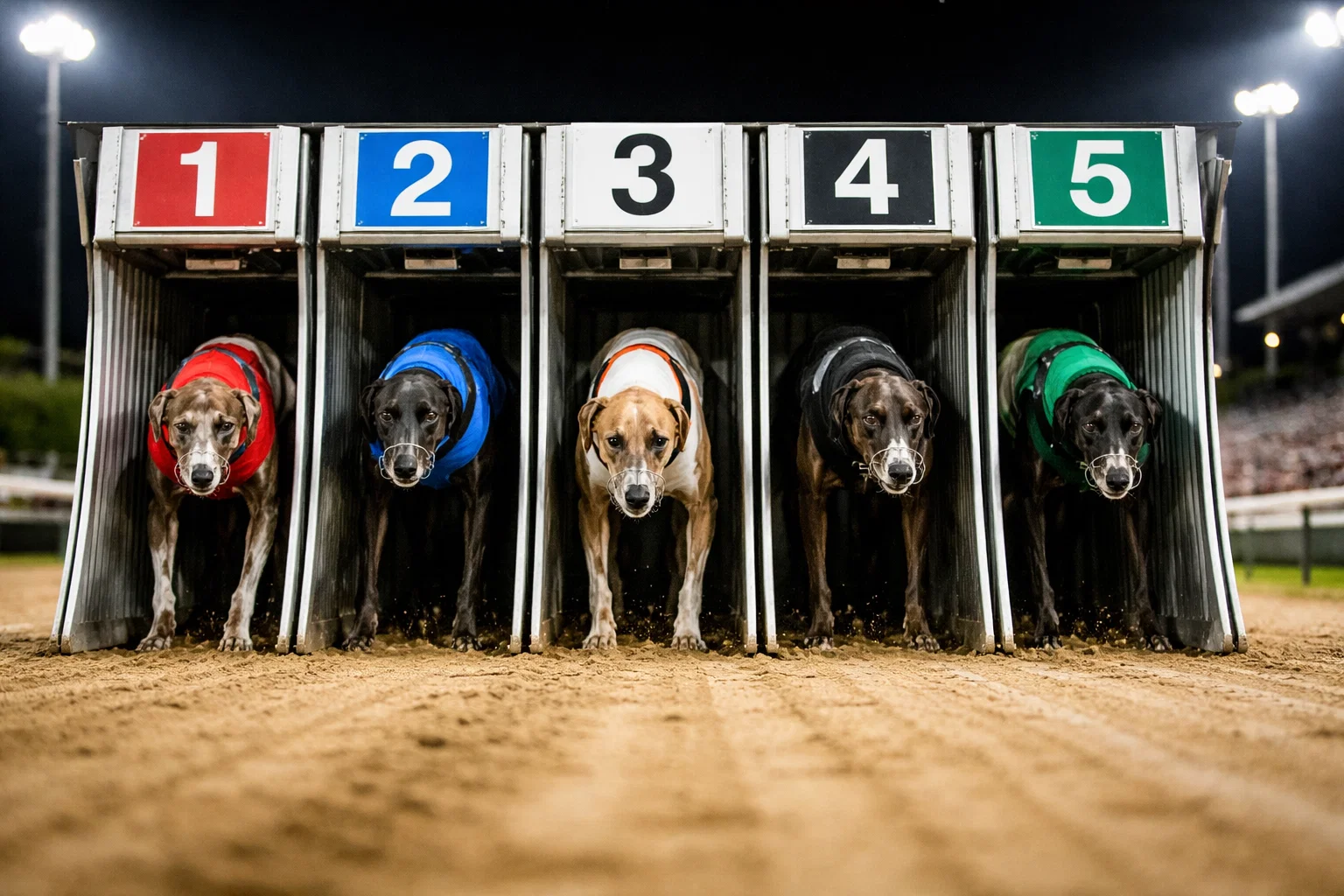
A friend once asked me why greyhound racing needs a grading system at all – “just let the fastest dogs race each other and be done with it.” The question made sense until I explained that without grading, every race would be a walkover for the top dog and a pointless exercise for the other five. The grading system exists to produce competitive fields, and at Harlow it works remarkably well. But it is not the only race type on the card, and understanding the difference between graded races and open races – and how that difference affects form analysis and betting – is fundamental to reading Harlow greyhound results with any sophistication.
See also: harlow greyhound results — complete Harlow greyhound analysis.
How GBGB Grading Classifies Greyhounds
The grading system at GBGB-licensed stadiums operates like a football league ladder. Dogs are assigned a grade based on their recent race times, and they race against others in the same grade. Win a race and you might move up a grade to face faster competition. Lose repeatedly and you drop down. The aim is to cluster dogs of similar ability, producing fields where any of the six runners has a realistic chance of winning.
At Harlow, grades run from A1 at the top – the fastest dogs on the track – down through A2, A3, and so on to A10 or lower. The grade boundaries are set by the racing manager based on calculated times: an A1 race over 415 metres at Harlow contains dogs whose recent times fall within a narrow band, and an A6 race contains dogs from a slower band. The 18 GBGB-licensed stadiums currently operating in the UK each set their own grade boundaries, which means an A3 dog at Harlow is not necessarily the same standard as an A3 at Romford – the grade is track-specific.
Regrading happens after every race. A dog that wins is typically moved up one grade for its next outing. A dog that finishes unplaced in two or three consecutive races may be dropped. The racing manager also considers the dog’s calculated time when regrading, so a dog that wins an A5 race in a very fast time might jump two grades to A3 rather than the standard single-grade promotion. This dynamic system keeps the grading accurate and responsive, but it also means that form is always in flux – yesterday’s A5 winner is tomorrow’s A4 contender, and the competitive landscape changes with every meeting.
What Open Races Are and When Harlow Schedules Them
Open races sit outside the grading ladder entirely. An open race has no grade restriction – any dog can enter, regardless of its current grade. The result is a field that can include an A1 flyer alongside an A4 plodder, and the form analysis is correspondingly more complex because you are comparing dogs from different levels of the grading hierarchy.
Harlow schedules open races infrequently compared to graded events. A typical weekly card at Harlow – which runs morning and evening meetings on Mondays, Wednesdays and Fridays plus Sunday mornings – is dominated by graded races, with open events appearing once or twice a week at most. Open races are more common on Friday evenings, when the card is designed to attract the week’s largest audience and a marquee open race adds spectacle.
Open races also attract entries from outside the regular Harlow pool. Trainers from other tracks may bring dogs to Harlow specifically for an open race, and these visitors add an unpredictability that graded races rarely produce. A visiting dog might have outstanding form at its home track but unknown credentials at Harlow’s tight 334-metre circuit, and that uncertainty creates both risk and opportunity for punters.
There are also categories between pure graded and fully open. Sprint open races might restrict entries to dogs with sprint form. Stayers’ open races require distance credentials. And some races are classified as “restricted open” – open to dogs above a certain grade, such as A3 or higher. These intermediate categories exist to keep the open-race concept competitive without allowing the field to become so unbalanced that the best dog walks the race.
How Race Type Affects Form Reliability
This is where the graded-versus-open distinction matters most for anyone betting on Harlow results. The reliability of form differs substantially between the two race types, and treating them the same is a recipe for losing bets.
In graded races, form is highly reliable. The dogs are clustered by ability, the grade boundaries are calibrated to local conditions, and the favourite wins approximately 36% of the time at Harlow – well above the 16.67% baseline if outcomes were random. The grading system is doing its job: identifying the best dog in the field accurately enough that the market prices it correctly more often than not. For punters, this means that form figures from recent graded races at Harlow are a strong predictor of future performance, and calculated times can be compared directly between dogs in the same grade.
Read about BAGS meetings in greyhound racing.
In open races, form reliability drops. The reason is simple: dogs from different grades have different ability ceilings, and comparing an A1 dog’s time to an A4 dog’s time is not an apples-to-apples exercise. The A1 dog may have faster times, but it earned those times against A1 opposition – competition that pushes it to maximum effort. The A4 dog’s slower times were set against A4 opposition, and it may have reserves of pace that its graded form does not reveal. When the two meet in an open race, the A4 dog’s true ceiling is unknown, and that uncertainty makes form analysis less definitive.
The market reflects this uncertainty. Favourites in open races at Harlow win at a lower rate than in graded races – closer to the national graded average of 32-35% rather than Harlow’s elevated 36%. The odds are more spread across the field, forecast dividends tend to be higher, and upsets are more frequent. For punters who enjoy finding long-priced winners, open races are the most productive hunting ground on the card. For those who prefer the discipline of form-based analysis with reliable data, graded races are the safer territory.
My approach is to treat the two race types as separate disciplines. I analyse graded races with a focus on calculated times, grade movements and running comments, trusting that the form book is an accurate guide. For open races, I shift my emphasis toward running style, trap draw and pace scenarios – because when the form book is less reliable, the race dynamics become the better predictor of what will happen.
