
BAGS Meetings in Greyhound Racing: How Bookmaker Fixtures Work at Harlow
 Available in US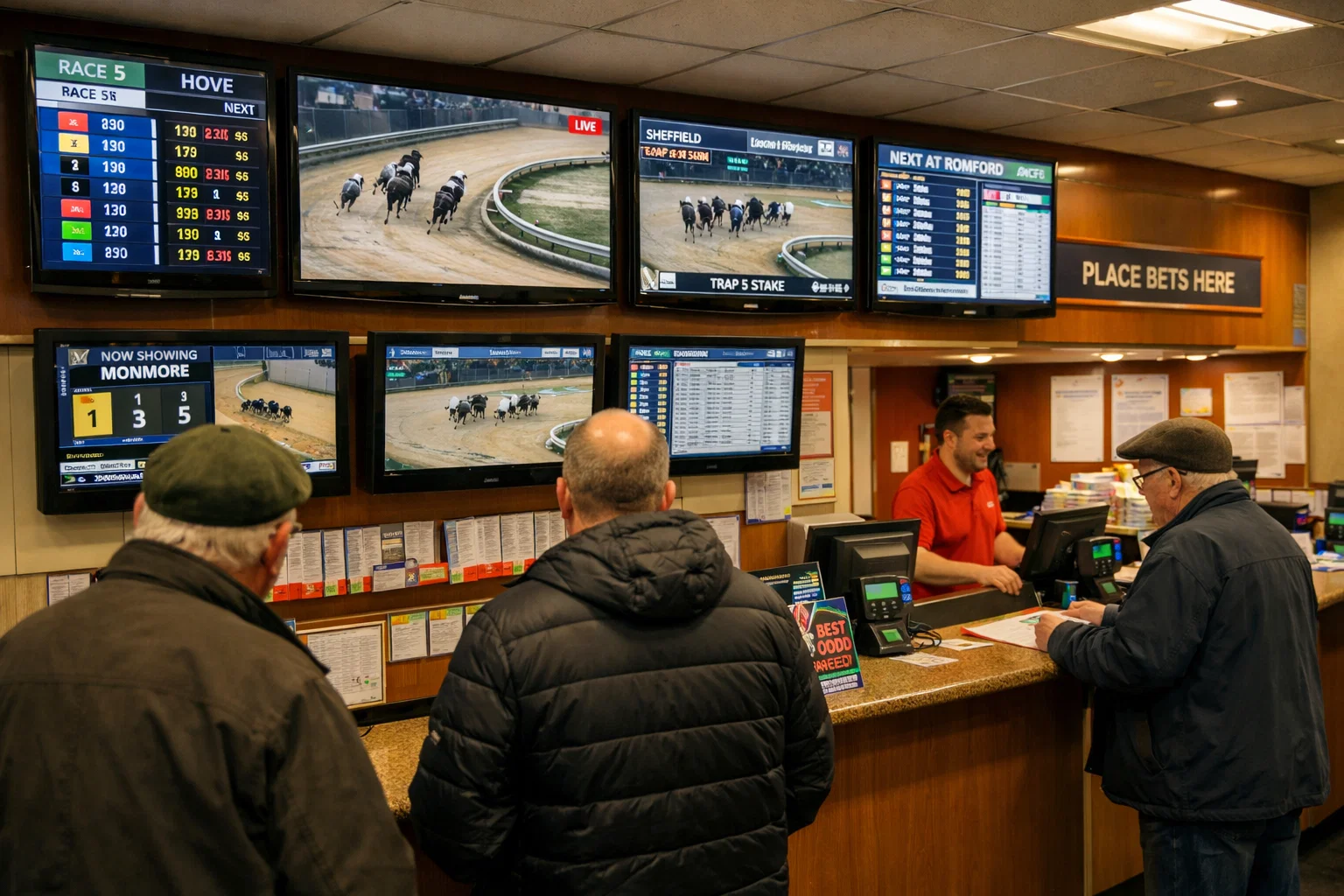
Walk into any high-street bookmaker in Britain on a weekday morning and the screens will be showing greyhound racing. The chances are good that at least one of those races is from Harlow. This is the BAGS system at work – the Bookmakers’ Afternoon Greyhound Service that keeps the tills ringing between horse racing fixtures and provides the commercial backbone of UK greyhound racing. Most punters interact with BAGS meetings every day without giving a thought to how the system operates, who pays for it, or why Harlow is central to the schedule. This piece fills in those blanks.
See also: harlow greyhound results — your Harlow greyhound racing centre.
What BAGS Stands For and How It Operates
BAGS – Bookmakers’ Afternoon Greyhound Service – is the framework through which greyhound racing is supplied to bookmaker shops and online platforms across the UK. The system is simple in concept: bookmakers need live sport to offer their customers during daytime hours, greyhound tracks need revenue to operate, and BAGS connects the two by scheduling races at staggered intervals throughout the day and broadcasting them through SIS to betting outlets nationwide.
The financial mechanics are important for understanding why BAGS matters. Bookmakers pay a levy on their greyhound betting turnover to the British Greyhound Racing Fund – in the 2024-25 financial year, that levy stood at 0.6% of turnover, generating approximately 6.75 million pounds for the BGRF. This money flows back into the sport through prize funds, welfare programmes and track infrastructure. The betting turnover on greyhound racing through bookmaker shops totalled 794 million pounds in the year from April 2023 to March 2024, and the overwhelming majority of that turnover was generated by BAGS meetings.
BAGS meetings are scheduled to avoid clashing with each other. The SIS broadcast system staggers race times across multiple tracks so that bookmaker customers always have a greyhound race available to bet on. A typical weekday BAGS schedule might have Harlow racing at 11:00, Romford at 11:12, Nottingham at 11:24, and so on in a rolling cycle. This staggering means a punter in a betting shop can move seamlessly from one race to the next without a break in the action – and the bookmaker can take bets continuously.
The scheduling is managed centrally, and each track is allocated a fixed number of BAGS fixture slots per week based on its capacity, track quality and geographic position. Harlow’s allocation reflects its status as a reliable, well-maintained track with consistent fields and a broadcast-ready infrastructure. Losing a BAGS slot would be commercially devastating for any track, which creates a strong incentive for stadiums to maintain high standards of track presentation and race quality.
Harlow’s Place in the BAGS Fixture Rota
Harlow races on Mondays, Wednesdays and Fridays with both morning and evening meetings, plus Sunday mornings. All of these fixtures are BAGS meetings, meaning they are broadcast through SIS and available for betting in every licensed bookmaker shop in the country. That schedule gives Harlow a substantial presence in the BAGS rota – six or more meetings per week, each contributing to the staggered broadcast cycle.
Harlow’s position in the BAGS schedule is not accidental. The track’s location in Essex places it within the SIS broadcast zone with minimal latency issues, its 334-metre circuit produces races of consistent length that fit neatly into the staggered timetable, and its grading system generates competitive fields that sustain betting interest. These operational qualities matter more than they might appear – a track that consistently produces non-competitive fields or suffers frequent technical issues risks losing its BAGS allocation, and with it the commercial revenue that keeps the stadium viable.
The BAGS system also dictates certain aspects of how Harlow’s card is constructed. Meeting length, number of races, intervals between races, and even the mix of distances are influenced by the broadcast schedule. A BAGS meeting at Harlow typically runs ten to twelve races over approximately two hours, with a new race off every ten to twelve minutes. That rhythm is designed to feed the broadcast cycle smoothly, and racing managers build their cards within these parameters.
BAGS Meetings vs Independent Open Meetings
Not all greyhound meetings are BAGS fixtures, though at Harlow the distinction is largely academic since virtually all racing is BAGS-scheduled. The alternative is an independent or “flapping” meeting – a non-GBGB-regulated event that operates outside the BAGS system. Flapping tracks set their own rules, are not covered by GBGB welfare standards, and do not contribute to the BGRF levy. Their results are not included in the official form book.
Understand graded vs open greyhound races.
For punters, the practical difference between a BAGS meeting and an independent meeting is data quality. BAGS meetings at GBGB-licensed tracks like Harlow produce standardised results with official timing, running comments, going allowances and calculated times. Every piece of data on the racecard has been collected under consistent conditions and can be compared meaningfully with data from other BAGS meetings at the same track. Independent meetings lack this standardisation, and their results should not be mixed into a Harlow form database.
The BAGS system is not without its critics. Some within the sport argue that the volume of BAGS fixtures dilutes field quality by spreading the dog population across too many meetings, and that fewer, higher-quality meetings would better serve both the dogs and the betting market. The 18 GBGB-licensed stadiums currently operating in the UK stage thousands of BAGS races annually, and the sheer volume means that some lower-grade meetings inevitably feature thin fields with limited competitive depth. That tension between volume and quality is an ongoing debate in UK greyhound racing, and it shapes the card at Harlow just as it does at every other BAGS track.
For the punter studying Harlow form, the key takeaway is this: BAGS meetings are the data pipeline. They produce the standardised, verifiable results that make form analysis possible, and they generate the betting turnover that funds the sport. Understanding BAGS is not just background knowledge – it is context for every number on the racecard.
