
Harlow Greyhound Results Friday: End-of-Week Card Analysis
 Available in US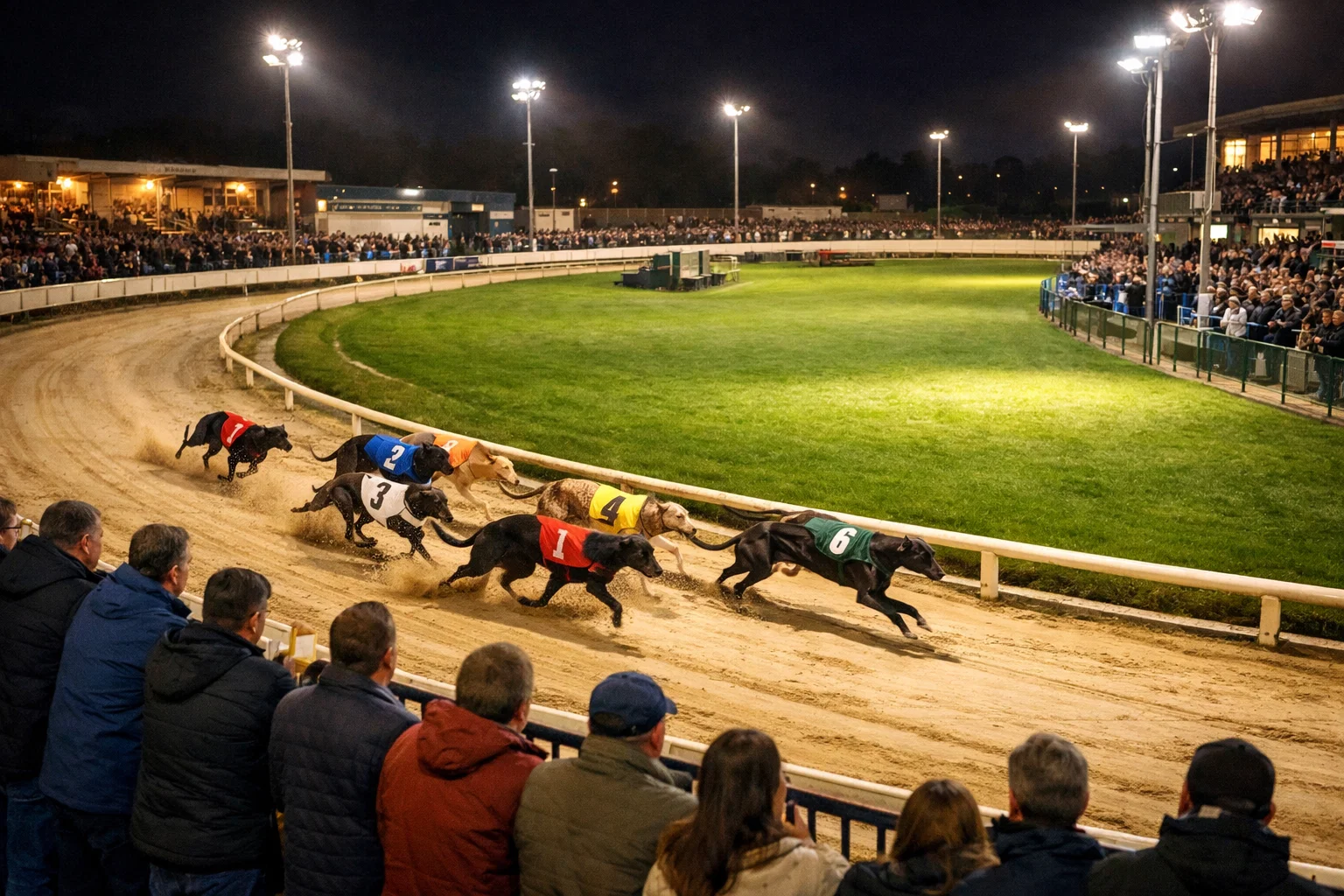
Friday night at Harlow is when the week’s form converges. The dogs that impressed on Monday and Wednesday carry their upgraded grades into the end-of-week card, the trainers bring their best stock for the largest audience, and the betting market sharpens with more money flowing through the ring. I look forward to Friday evenings at Harlow more than any other session – not because the racing is predictable, but because the accumulated data from Monday and Wednesday gives me the most complete picture of any card during the week. If you are going to study one day at Harlow seriously, Friday is the day that rewards preparation most generously.
See also: harlow greyhound results — your go-to Harlow greyhound site.
What Defines a Harlow Friday Meeting
Harlow runs morning and evening meetings on Fridays, and the evening session is the flagship fixture of the week. The stadium, which can accommodate 1,500 spectators with parking for 400 cars, sees its highest attendance numbers on Friday evenings, and the atmosphere has a different energy to the quieter Monday and Wednesday sessions. The on-course bookmakers pitch more competitively, the tote pools are larger, and the card itself tends to be the most carefully assembled of the week.
The Friday card benefits from four days of racing data. Monday’s results informed Wednesday’s grading, and Wednesday’s results now feed into Friday’s card. The racing manager has the fullest possible picture of each dog’s current form when putting Friday’s grading together, and the result is a card where the grading is at its most accurate. That accuracy is a double-edged sword for punters: on one hand, the races are more competitive because dogs are correctly graded; on the other, correctly graded fields are harder to separate, which means finding value requires deeper analysis.
Harlow has held racing since opening in 1995, and the Friday evening fixture has been a staple of the Essex greyhound calendar for three decades. The first televised Harlow meeting on Sky Sports came in 2011, and while not every Friday card makes the television schedule, the Friday evening slot is the one most likely to attract broadcast attention. SIS streams all Harlow fixtures to bookmaker platforms, ensuring that even Friday meetings without Sky Sports coverage are available to watch and bet on remotely.
Grading Patterns and Card Quality on Fridays
Friday cards at Harlow consistently feature the week’s highest-quality graded races. The A1 grade – the top tier of Harlow’s grading ladder – appears more frequently on Friday evening cards than on Monday or Wednesday, because trainers with top-grade dogs tend to target the end-of-week fixture where the competition is strongest and the audience is largest.
This concentration of quality at the top of the card has a knock-on effect lower down. When the best dogs are racing in A1 and A2 on Friday, the A3-to-A5 grades absorb dogs that might have been in higher grades earlier in the week but did not perform. The result is that mid-grade races on Friday can be exceptionally competitive – full of dogs that narrowly missed out on a higher grade and are running with a point to prove. These races are often the best betting opportunities on the card because the market underestimates the competitiveness of the mid-range.
Friday evening cards also include the week’s most frequent open races, though these remain relatively rare at Harlow compared to graded events. Open races attract entries from a broader pool, including dogs from other tracks that are brought in specifically for the Friday fixture. When an open race appears on the Friday card, the form analysis becomes more complex because the visiting dogs may not have Harlow-specific form to study – their times were set on different tracks with different geometries, and direct comparisons require adjustments for circuit length and going.
The favourite win rate on Friday evenings at Harlow hovers around the track average of roughly 36%, but the average masks an interesting split. In the top grades – A1 and A2 – favourites actually win slightly less often on Fridays because the fields are so tightly graded that any dog in the race can win. In the lower grades – A7 and below – favourites on Fridays tend to have higher strike rates because the grading system has had all week to sort dogs into appropriate bands, and the best dog in a lower-grade field is genuinely the best dog.
Betting Market Differences on Friday Evenings
Richard Brankley, SIS’s Head of Greyhound Operations, has acknowledged the logistical importance of staging meetings at different UK tracks, and that importance is amplified on Fridays when multiple GBGB circuits are racing simultaneously. The betting market for Harlow’s Friday card is deeper and more liquid than on Monday or Wednesday, which has both advantages and disadvantages for the punter.
View the Monday results at Harlow greyhounds.
The advantage of a deeper market is price stability. On a quiet Monday morning, a single large bet can shift the odds on a dog significantly, sometimes creating false signals that confuse the form picture. On Friday evening, the volume of money flowing through the market absorbs individual bets without dramatic price movements, and the odds you see at mid-afternoon are likely to hold closer to post time. This stability makes it easier to assess value: the price you identify in your form study is the price you are likely to get.
The disadvantage is that deeper markets are more efficient. The soft prices that occasionally appear on Monday – a 4/1 shot that should be 3/1 – are rarer on Fridays because more punters are studying the card and more money is correcting pricing errors. Finding value on a Friday evening card requires either a genuinely original angle on the form or an ability to read pace scenarios that the market has not priced correctly. Trap bias, running-style clashes, and going-condition shifts are the three areas where I most often find Friday value, because they require track-specific knowledge that casual punters rarely possess.
Forecast and tricast dividends on Friday evenings tend to be slightly lower than on quieter days for the same result, because the larger tote pools distribute the payout across more winning tickets. However, the bigger pool also means that unusual results – an outsider in first or second – produce healthier dividends than you might expect, because the pool weight is concentrated on the favourites and the long-shot dividend is amplified. If you back forecasts through the tote on Fridays, targeting results that the crowd has overlooked is the most productive strategy.
