
Harlow Greyhound Results Yesterday: Where to Find Them and What to Look For
 Available in US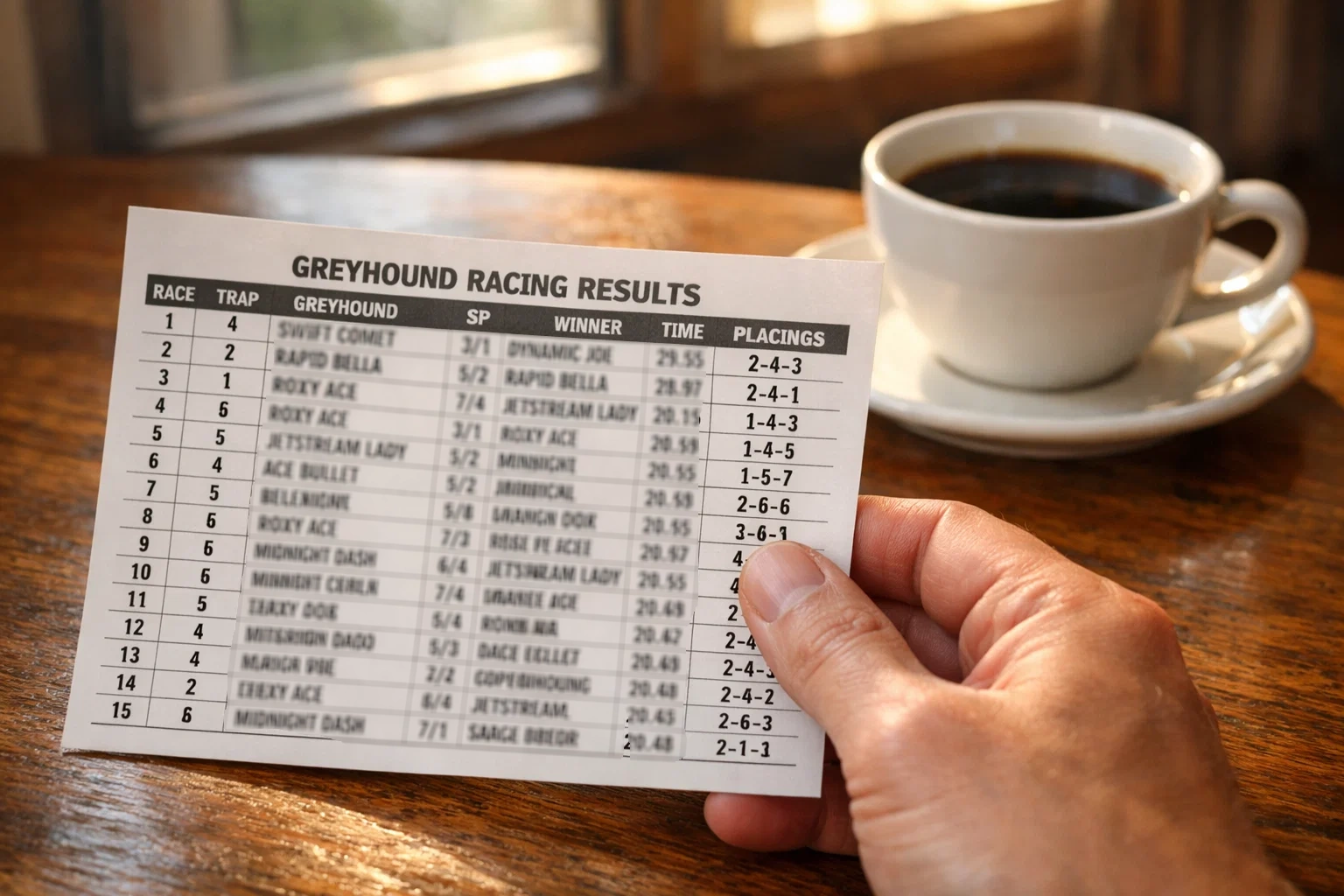
Every serious form student at Harlow starts the day the same way: pulling up yesterday’s results before looking at tonight’s card. I do it before my first cup of coffee most mornings, because those fresh results are the raw material from which tonight’s grading decisions are made and tomorrow’s selections are built. The dogs that won yesterday are carrying upgraded expectations into their next outing. The dogs that lost may be dropping a grade. And the dogs that encountered trouble – crowded at the first bend, bumped on the back straight – are the hidden opportunities that most punters overlook because they only see the finishing position, not the story behind it.
See also: harlow greyhound results — the Harlow greyhound racing guide.
Where to Find Yesterday’s Harlow Results
Results from Harlow meetings are published across multiple platforms within minutes of each race finishing, and the full card is usually available on all major sites by the time the last race is run. The fastest official source is GBGB’s own results service, which covers all 18 licensed stadiums currently operating in the UK and publishes finishing positions, times, starting prices and running comments for every runner.
Beyond the official GBGB platform, results appear on racing data sites, bookmaker results pages and specialist greyhound portals. The depth of detail varies: some platforms publish only finishing positions and times, while others include the running comments, going allowance, calculated times and trainer information that make the data genuinely useful for form analysis. I always use a source that includes running comments, because without them the results are just a list of numbers with no narrative. A dog that finished fifth with “BCrd 1st, Ck 3rd” had a completely different race to a dog that finished fifth with “Led, Led, Fdd, 5th” – and that distinction only shows up in the comments.
One platform quirk to be aware of: some international-facing results sites carry Harlow data but with a delay or with incorrect terminology. I have seen US-focused sites refer to greyhound handlers as “jockeys,” which is a red flag for data accuracy. Stick to UK-based sources that use standard GBGB terminology and publish results promptly – typically within 30 minutes of the final race.
Key Data Points to Extract From Yesterday’s Card
Not all of yesterday’s results are equally useful. The information that matters for tonight’s selections falls into three categories: form updates, grading signals and going data. Let me take each in turn.
Form updates are the most obvious takeaway. Every result updates a dog’s form line, and that updated line is what tonight’s grading and pricing will reflect. But do not just look at finishing positions. Compare yesterday’s calculated time to the dog’s previous times at the same distance – an improvement of 10 hundredths of a second (one “spot”) is significant at Harlow’s distances, and a decline of the same amount might indicate the dog is past peak fitness. The favourite at Harlow wins about 36% of graded races, but that figure masks the fact that favourites whose recent calculated times are improving win at a meaningfully higher rate than those whose times are static or declining.
Grading signals come from the combination of yesterday’s finishing position and the grade in which the dog raced. A dog that won an A6 race yesterday is almost certainly moving to A5 or higher tonight. A dog that finished last in A3 might drop to A4. These movements are not guaranteed – the racing manager has discretion – but the general pattern is reliable enough to predict most regrades within one level. Anticipating the regrade before the card is published gives you a head start on the market, because you know which dogs will be facing weaker or stronger opposition tonight before the odds are formed.
Going data from yesterday’s card tells you what the track surface was doing and how it affected different running styles. If yesterday’s going was slow and front-runners faded in the closing stages, that is useful context if tonight’s going is similar. If yesterday’s going was fast and early-pace dogs dominated, tonight’s fast-breaking runners become more attractive. The going allowance published for yesterday’s meeting is the reference point: compare it to the going allowance for tonight’s card, and adjust your form expectations accordingly.
Rolling Yesterday’s Data Into Tonight’s Picks
The practical value of yesterday’s results is not in studying them as historical artefacts but in feeding them into a live decision-making process. Here is the workflow I use every race day at Harlow, and it starts with yesterday’s card.
View the Monday results at Harlow.
First, I identify “excuse” runners from yesterday – dogs whose finishing position was worse than their ability because of in-running trouble. These are the “BCrd,” “Ck,” “Fell” runners whose running comments explain a poor result. If one of these dogs appears on tonight’s card, especially in a lower grade after yesterday’s poor finish, it becomes an immediate watch-list entry. The market will price it based on yesterday’s finishing position, not on the excuse, and that pricing error is the most consistent source of value I find at Harlow.
Second, I look for “form improvers” – dogs whose yesterday’s calculated time was notably better than their previous run. A time improvement suggests the dog is on an upward trajectory, and if the regrade has not caught up with the improvement (which often happens when the time improvement is modest), the dog may be underpriced tonight.
Third, I note the going allowance from yesterday and compare it to the forecast for tonight. If the going is changing direction – from fast to slow or vice versa – I reassess every selection on tonight’s card for going suitability. A dog that looked a certainty on fast going may be vulnerable if tonight’s surface is riding slower, and yesterday’s data is the closest reference point for how the track is currently behaving.
This three-step process – excuses, improvers, going shift – takes about twenty minutes per card and consistently produces two or three actionable angles that are not visible in tonight’s racecard alone. It is the single most productive habit I have developed in a decade of Harlow form study, and it starts with yesterday’s results.
