
Harlow Stadium Race Schedule 2026: Meeting Times, BAGS Fixtures and Live Streaming
 Available in US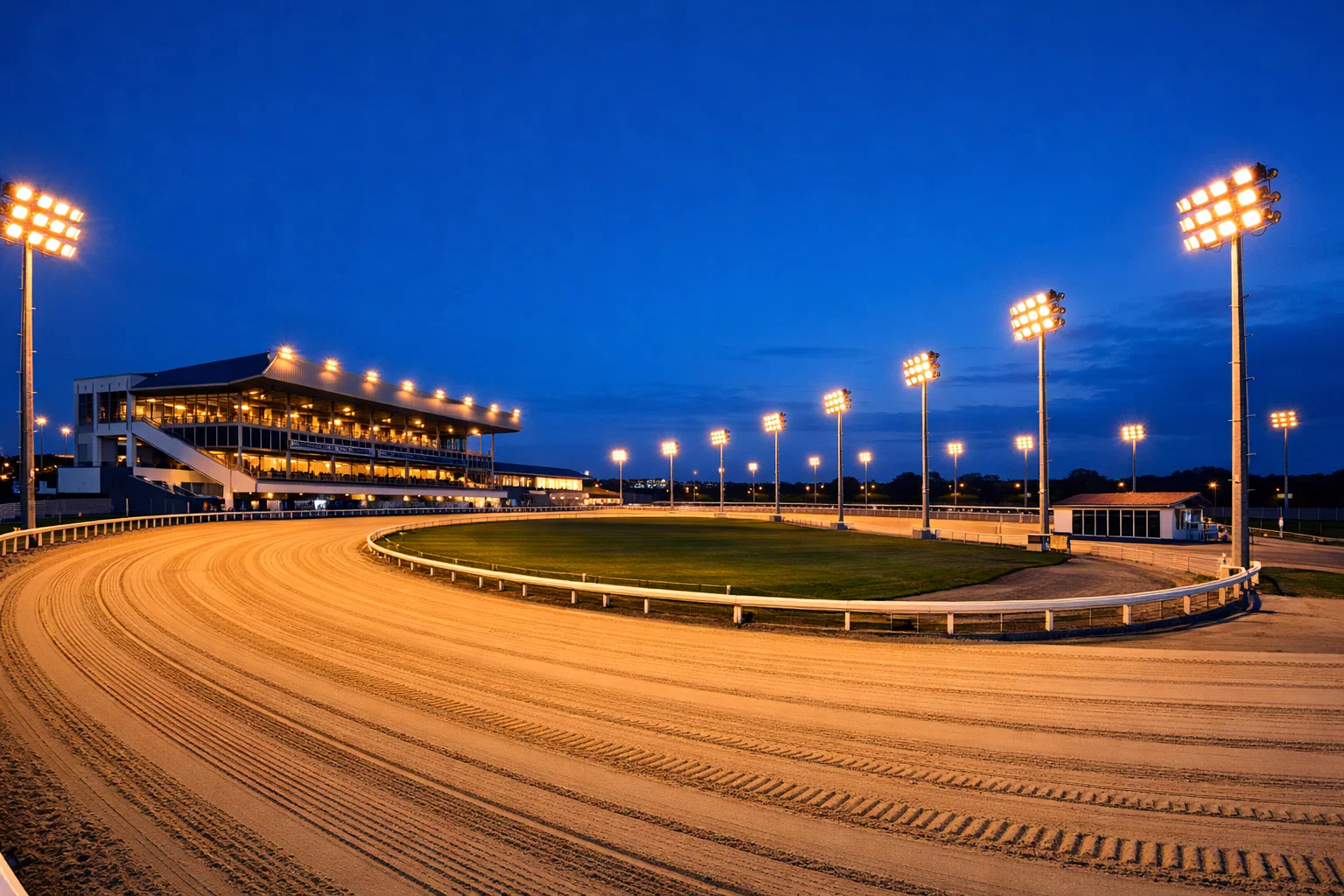
I missed a Harlow evening meeting last year because I assumed the Friday card started at the same time as the Monday one. It didn’t. A wasted drive and an empty car park taught me something that should have been obvious: knowing when Harlow races is not the same as assuming when Harlow races. The schedule has structure, but it has quirks, and the difference between the two catches out even people who attend regularly.
Harlow Greyhound Stadium runs races on Mondays, Wednesdays and Fridays — both morning and evening sessions — plus Sunday mornings. That fixture pattern makes it one of the busiest stadiums on the BAGS circuit, and the regularity is a gift for form analysts because it generates a continuous stream of results to work with. But regularity doesn’t mean uniformity. Morning and evening meetings differ in grading depth, going conditions and market liquidity. The number of races per card varies. Sunday meetings follow a different structure from midweek fixtures.
This guide maps out the full Harlow fixture pattern for 2026: when meetings happen, what distinguishes one from another, how the BAGS system shapes the schedule, where to find live coverage and what to expect if you’re visiting the stadium in person. Whether you’re planning tonight’s selections from a sofa or driving to the track on a Friday, everything you need to know about when and how Harlow operates is here.
See also: harlow greyhound results — all Harlow greyhound results and tips.
Weekly Fixture Pattern: Monday, Wednesday, Friday and Sunday
Harlow’s weekly rhythm is built around four racing days: Monday, Wednesday, Friday and Sunday. The first three carry both morning and evening meetings, giving the track six sessions across three days. Sunday adds a morning-only fixture. That’s seven meetings per week in a normal cycle — a volume that only a handful of GBGB-licensed stadiums match.
Monday meetings set the tone for the week. The morning card typically goes off mid-morning, with races spaced at roughly ten-minute intervals across a programme of ten to twelve races. The evening session follows after a break, with first race times varying slightly depending on the time of year and the SIS broadcast schedule. Monday’s card often features dogs that last ran on the previous Friday, so the form cycle is tight — you’re looking at performances just three days old, which is fresh enough for condition and going data to carry real weight.
Wednesday is the midweek fixture and in many ways the most stable day on the calendar. The card structure mirrors Monday: morning and evening, ten to twelve races per session. Wednesday’s grading typically reflects Monday’s results — dogs that won or ran well on Monday may be re-graded upward for Wednesday, while those that underperformed might drop. This creates a natural momentum through the week that rewards punters who track results across consecutive meetings rather than treating each card in isolation.
Friday carries a slightly different energy. The evening card often attracts the week’s strongest fields, partly because trainers target Friday for dogs they believe are ready to perform and partly because the Friday evening slot historically draws more attention from the streaming audience. At some GBGB tracks, the Friday card includes an occasional open race — a higher-quality event outside the standard grading structure — though at Harlow these are less frequent than at flagship venues like Nottingham or Romford.
Sunday morning is the fourth fixture day. The format is a single morning session, shorter than the weekday equivalent, often running eight to ten races. Sunday at Harlow is a quieter affair: the betting market is thinner, the grading pool can produce softer fields and the going may differ from the Friday evening surface because the track has sat unused overnight. For form purposes, Sunday results feed into Monday’s grading, completing the weekly loop.
The consistency of this pattern is one of Harlow’s strengths. Unlike tracks that race sporadically or shift fixtures at short notice, Harlow’s Monday-Wednesday-Friday-Sunday cycle provides a predictable framework for planning your analysis. You know when the data is coming, you know how the grading flows from one day to the next, and you can build a weekly routine around the fixture list with confidence that the schedule will hold. For anyone using the schedule as the backbone of a form project, the race card reading guide explains what to extract from each card once you know which meetings to target.
Morning vs Evening Meetings: What Changes?
On paper, a morning meeting and an evening meeting at Harlow are the same product: six dogs, same distances, same grading tiers. In practice, they feel like different events, and the differences affect your selections.
Morning meetings race on a surface that has typically been prepared overnight or in the early hours. In cooler months, that surface retains more moisture, producing a slower going allowance than the evening card will carry after a day of ambient warming and foot traffic from the morning session itself. I’ve recorded morning going allowances at Harlow running ten to fifteen hundredths of a second slower than the same day’s evening figure. That gap might sound trivial, but over 415 metres it translates to measurable differences in calculated times, and it favours front-runners who benefit from a surface that saps the closing pace of challengers.
The grading pool also shifts between sessions. Morning meetings sometimes feature dogs in transitional grades — animals that have just been re-graded after a strong or weak run and are being given their first outing at the new level in a less pressured morning environment. Evening cards tend to carry the sharper end of the grading pool, particularly on Fridays when trainers target the higher-profile slot for their best performers. The practical implication is that morning cards can produce more surprises: dogs running at unfamiliar grades, encountering unfamiliar opponents, in going conditions that differ from their most recent form.
Market liquidity also diverges. Morning BAGS meetings generate lower turnover than evening sessions, which means the odds can be less reliable as a guide to true probability. Bookmaker tissue prices for morning meetings are compiled with less data input from the betting public, so the opening prices carry more weight through to the SP. For a punter who does their own form work, this is an advantage — a thinner market is easier to beat because there’s less collective intelligence baked into the price. For a casual punter relying on the favourite, the thinner market introduces more noise. Over a calendar year, I’ve found my strike rate on morning Harlow meetings runs slightly higher than on evening cards, precisely because the market is less efficient.
BAGS Meetings at Harlow: What They Are and Why They Matter
Every racing meeting at Harlow that is broadcast into betting shops and streamed online is a BAGS fixture — part of the Bookmakers’ Afternoon Greyhound Service. Understanding what BAGS is and how it shapes the schedule matters because it explains why Harlow races when it does, how the card is structured and where the money behind the sport comes from.
BAGS is the commercial framework that connects greyhound tracks with bookmakers. Tracks agree to stage meetings at scheduled times and in a format that bookmakers can broadcast to their customers. In return, bookmakers pay a fee and contribute to the BGRF levy — currently 0.6% of greyhound betting turnover. In the 2024-25 financial year, that levy generated 6.75 million pounds for the British Greyhound Racing Fund, which distributes money to welfare programmes, prize funds and track infrastructure. The entire ecosystem — track, bookmaker, punter — is tied together through this arrangement.
For Harlow, being on the BAGS rota means the fixture list is not set by the track alone. SIS, the company that handles the broadcast and data distribution for BAGS meetings, plays a coordinating role in scheduling. Meeting times are calibrated to avoid clashes with other BAGS fixtures at other tracks, ensuring bookmakers always have a greyhound product available for their customers throughout the day. This is why Harlow’s first races don’t go off at random times — they slot into a national broadcast timetable that keeps the supply of live racing constant from morning to night.
The BAGS structure also influences race programming. Meetings are designed to run efficiently within a broadcast window, which means a fixed number of races spaced at regular intervals. The grading must fill every race with six competitive runners, which requires a deep enough pool of locally kennelled dogs. Harlow’s location in Essex, within reach of a large number of trainers across the south-east, gives it the population density to sustain seven meetings a week without the grading becoming dangerously thin. Tracks with smaller catchment areas often struggle to fill BAGS cards, which is one reason why some venues have reduced their fixture count in recent years.
Betting turnover on BAGS greyhounds dwarfs on-course attendance revenue. The 794 million pounds in bookmaker shop turnover for the 2023-24 financial year represents the commercial heartbeat of the sport. A Harlow meeting might be watched by a few hundred people trackside, but it is bet on by thousands across the country. That dynamic shapes everything — the schedule, the investment in track maintenance, the prize money and, ultimately, the quality of dogs that trainers bring to the track.
Trial Sessions and Non-Race Fixtures
Not every session at Harlow is a competitive meeting. Trial days sit outside the main fixture list and serve a purpose that regular race cards can’t: giving dogs a controlled run on the circuit without the pressure of competition.
Trials at Harlow are used for several reasons. A dog returning from injury needs a trial to prove its fitness before being entered into a graded race. A dog transferring from another track to a Harlow-based trainer needs a trial to establish a baseline time on this specific circuit. A young dog approaching its racing debut needs a trial to gain experience of the traps, the bends and the hare. Trainers also use trials to test a dog over a distance it hasn’t raced at — a proven 415-metre runner might trial over 238 metres before being entered in a sprint for the first time.
Trial times appear on some race cards as part of a dog’s form history, usually marked with a “T” to distinguish them from competitive results. The critical thing to understand is that trial times are not directly comparable to race times. In a trial, the dog is running alone or in a small group without the adrenaline, crowding and competitive pace of a six-dog race. Trial times are typically a few tenths of a second slower than competitive equivalents, though the gap varies by dog and by distance. Treat them as directional — a fast trial suggests a dog in good condition — rather than as a precise form indicator.
Trial sessions at Harlow are not broadcast on SIS or available through bookmaker streaming. Results may be published on the GBGB website or communicated through the trainer, but they don’t receive the same distribution as competitive race results. If you see a trial time cited on a race card for a debutant, it’s worth noting but not worth building your entire assessment around.
How to Watch Harlow Races Live
Harlow’s first televised meeting came through Sky Sports in 2011, and that broadcast deal marked a turning point for the track’s profile. Today, live coverage of Harlow meetings reaches punters through multiple channels, and you don’t need a satellite dish to watch.
SIS — Satellite Information Services — is the primary distributor of BAGS racing into betting shops and online platforms. Every scheduled Harlow meeting is covered by SIS, which means the races are available on any bookmaker platform that carries the SIS feed. Most major online bookmakers offer live greyhound streaming to customers who hold a funded account or have placed a bet on the meeting. The stream quality varies by platform but is generally sufficient for following the action and — importantly — for timing first-bend sectionals if you’re building your own form data.
Richard Brankley, SIS’s head of greyhound operations, has spoken publicly about the logistical ambition behind the BAGS coverage network, noting the importance of geographic spread in staging meetings efficiently. Harlow benefits from that network because its Essex location fills a scheduling slot that serves the south-east betting market without clashing with nearby fixtures at Romford or Central Park.
Sky Sports still covers selected greyhound meetings, though its commitment to the sport has fluctuated over the years. Harlow is not a regular fixture on the Sky Sports schedule — the channel tends to prioritise flagship open-race meetings at larger venues — but occasional appearances do occur. For day-to-day coverage, SIS through a bookmaker account is the reliable route.
If you want to watch without a betting account, options are limited. Some free streaming sites have carried BAGS greyhound coverage in the past, but availability is inconsistent and the legality can be ambiguous. The simplest and most dependable approach is to open an account with a licensed bookmaker, deposit the minimum amount and access the SIS feed directly. It costs almost nothing and gives you a legitimate, stable stream for every Harlow meeting on the calendar.
Visiting Harlow Stadium: Parking, Capacity and Entry
Harlow Stadium sits in the Pinnacles industrial area of Harlow, Essex, accessible from the M11 and within reasonable reach of the M25. If you’re driving, the stadium’s car park holds around 400 vehicles, which is ample for all but the busiest open-race nights. Parking is typically free on standard BAGS meeting days.
The stadium’s capacity is approximately 1,500 spectators, a figure that reflects its purpose-built design from the 1995 opening. Inside, the layout is functional rather than glamorous: a main grandstand with viewing areas, a bar and catering facilities, and trackside seating that puts you close enough to feel the sand kick up on the bends. For a BAGS meeting, you won’t be fighting for space — weekday attendance is modest, and the atmosphere is relaxed.
Entry fees and door policies vary depending on the type of meeting. Standard BAGS fixtures may carry a small admission charge or be free to enter, depending on the promotion. Special events, open-race nights and hospitality packages are priced separately and usually require advance booking through the track’s own website. If you’re planning a first visit, check the stadium’s event page for the specific meeting you want to attend — the information is updated regularly and includes any restrictions or dress code requirements for hospitality areas.
Public transport access is workable but not seamless. Harlow Town railway station is the nearest mainline stop, served by Greater Anglia trains from London Liverpool Street. From the station, the stadium is a short taxi ride or a longer walk through the industrial estate. There’s no dedicated bus service to the track on race nights, so a car is the more practical option for evening meetings.
Fixture Changes, Cancellations and Where to Check
Harlow’s fixture list is stable by greyhound racing standards, but cancellations and changes do happen. Extreme weather is the most common cause — heavy snow, severe frost or waterlogging can make the track unsafe, and the racing manager has the authority to cancel or postpone at short notice. In the 2025-26 winter period, a handful of morning meetings were called off due to frozen surfaces, with the decisions communicated via social media and the GBGB website within hours of the scheduled start.
Track maintenance can also force a fixture shift. Periodic re-sanding, drainage work or equipment upgrades occasionally require a meeting to be rescheduled rather than cancelled outright. When this happens, the replacement fixture is usually slotted into the same week to maintain the BAGS broadcast schedule, which means a Monday meeting might move to Tuesday or a Friday session might be brought forward to Thursday.
The best sources for real-time fixture information are the Harlow Stadium website and social media channels, the GBGB’s official fixture list and the SIS schedule published through bookmaker platforms. I check two of these sources before making any plans for a specific meeting, because no single channel is perfectly reliable. If in doubt, a phone call to the stadium on the morning of the meeting will confirm whether racing is going ahead.
Frequently Asked Questions
Plan the Card Before the Card Plans You
Knowing Harlow’s schedule inside out is the foundation that everything else — form analysis, trap bias work, staking discipline — sits on. You can’t assess a card you didn’t know was happening, and you can’t compare morning form with evening form if you don’t understand the structural differences between the two sessions. The fixture pattern at Harlow is one of the most consistent in UK greyhound racing, and that consistency is an asset for anyone willing to treat the sport as a data project rather than a lucky dip.
Check the Monday results at Harlow greyhounds.
The eighteen GBGB-licensed stadiums still operating across England represent a circuit that has contracted sharply — down from seventy-seven at the peak in the 1940s — but Harlow’s position on that circuit is secure for now. Its regular fixtures, its SIS coverage and its accessible location in Essex make it a reliable anchor point for anyone building a form database or a betting approach around UK greyhound racing. The schedule is set, the data is flowing and the races keep coming. The only question is whether you’ll be ready when the traps open.
