
How to Read a Greyhound Race Card: Every Column Explained With Harlow Examples
 Available in US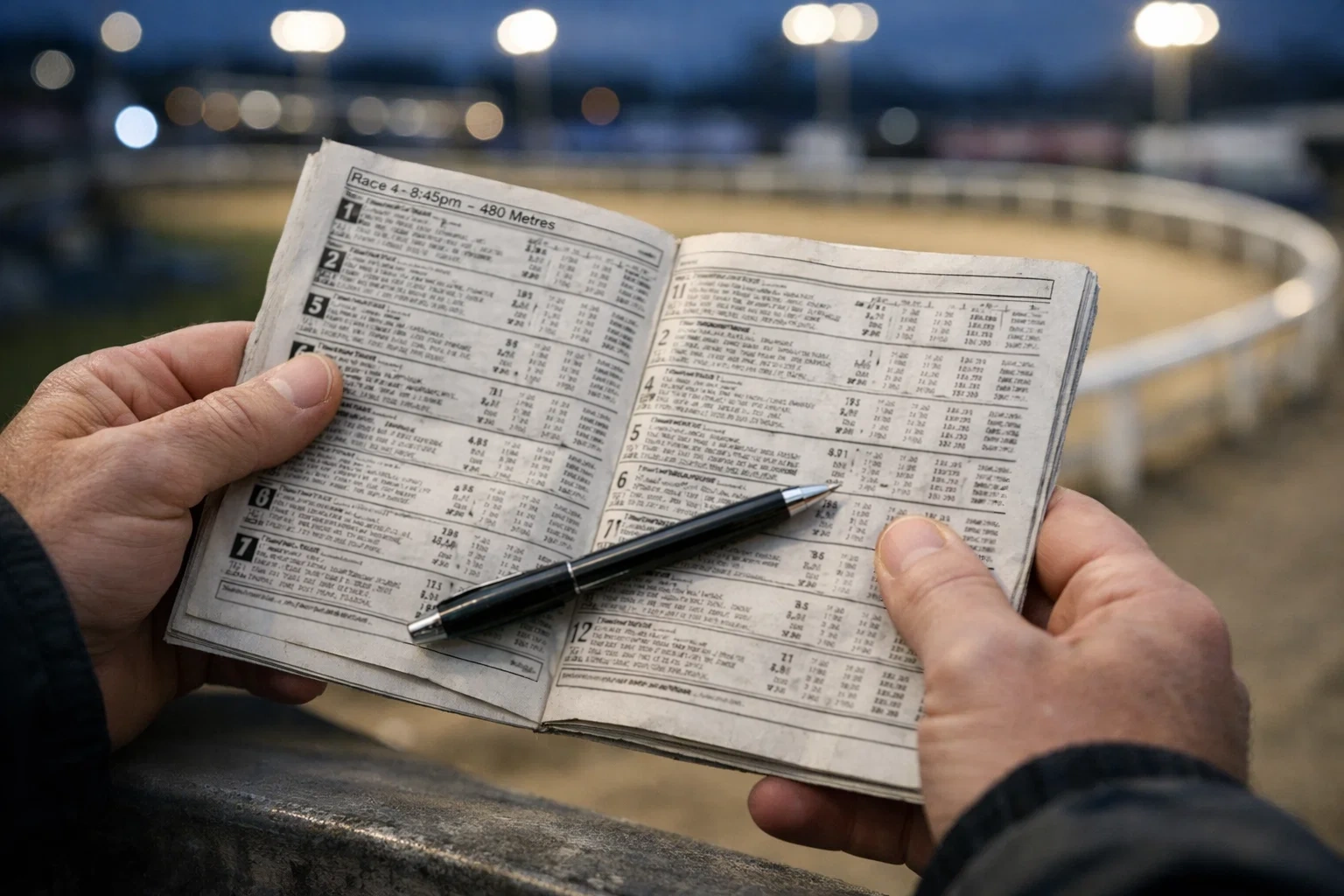
The first greyhound race card I ever held looked like a weather forecast written in Morse code. Columns of numbers, cryptic three-letter abbreviations, weights listed to the tenth of a kilogram, and a string of digits next to each dog’s name that apparently told a story I couldn’t read. I placed a bet on the dog with the coolest name, lost, and spent the drive home wondering what all those numbers had been trying to tell me.
A decade later, I can glance at a Harlow race card and build a mental picture of each race within minutes — who’s likely to lead, which dog is dropping in grade, whether the going suits a front-runner or a closer. That fluency isn’t talent; it’s pattern recognition, and it starts with understanding what each column on the card represents and why the compiler put it there. Once the layout clicks, you stop seeing a wall of data and start seeing a narrative.
This guide breaks a standard Harlow race card into its component parts, column by column. Every example uses terminology and formatting you’ll encounter on cards from Harlow’s 334-metre circuit, though the principles apply to any GBGB-licensed track. By the end, you’ll be able to extract more useful information from a single race card than most casual punters gather in an evening.
See also: harlow greyhound results — comprehensive Harlow greyhound coverage.
Anatomy of a Greyhound Race Card
Pick up any race card for a Harlow meeting and you’ll see the same basic architecture repeated for every race on the programme. The header tells you the race number, the distance, the grade and the scheduled off time. Below that, six rows — one per runner — lay out the detail that separates a blind punt from an informed selection.
The leftmost column is the trap number, printed against the colour of the jacket the dog will wear: red for Trap 1, blue for 2, white for 3, black for 4, orange for 5 and black-and-white stripes for 6. These colours are universal across all GBGB tracks, so once you’ve memorised them at Harlow they work everywhere.
Next to the trap number you’ll find the dog’s name, registered with the GBGB and often reflecting its sire line or breeding kennel. Beneath the name — or alongside it, depending on the card format — sits the trainer’s name and sometimes the owner. The trainer matters more than you might think; certain trainers at Harlow have notably higher strike rates in specific grades, and spotting that pattern on the card is the first step towards using it in your assessment.
The form figures column is the densest piece of real estate on the card. It shows the dog’s finishing position in its most recent races, reading left to right from oldest to newest. A string like 231142 tells you the dog finished second, third, first, first, fourth and second across its last six outings. Letters mixed in with the numbers — such as a capital “W” for a wide run or “F” for a fall — add context that the raw positions alone can’t convey. I’ll unpack these in the next section.
You’ll also see the dog’s weight, listed in kilograms to one decimal place. Weight is recorded at kennelling before each meeting, so it reflects the dog’s condition on race day, not some historical average. Alongside the weight, the card shows the dog’s date of birth or age, its colour and its sex. A bitch in season will be withdrawn, so you’ll only see dogs that are fit to race.
The right side of the card carries the previous race details: the track where the dog last ran, the distance, the finishing time, the calculated time (more on that shortly) and the in-running comment that describes how the race unfolded for that dog. Some cards also show the starting price from the dog’s last run, which gives you a snapshot of how the market rated it last time out.
At the foot of each race section you may see a comment from the race compiler — the person responsible for grading the runners and writing brief notes on each dog’s prospects. These notes are subjective, but they can flag things like a dog returning from injury or switching to an unfamiliar distance, both of which might not be obvious from the numbers alone.
The entire structure is designed to give a knowledgeable reader everything needed to assess a race in a few minutes. The trick is learning which columns to prioritise for the question you’re trying to answer, rather than trying to absorb all of it at once.
Form Figures: What the Numbers and Letters Mean
I once watched a newcomer at Harlow dismiss a dog showing 665431 in its form line because “it was finishing sixth a few runs back.” What he missed was that the sequence told a clear story of a dog that had been out of form, found its feet and was now peaking — the classic improving profile. Reading form figures isn’t about scanning for ones and twos; it’s about reading the trend.
Each number in the form string represents the dog’s finishing position in a single race, reading from oldest on the left to most recent on the right. A “1” means a win, “2” a second place, and so on up to “6” in a standard field. If the dog finished outside the first six — possible in larger fields at some tracks, though Harlow races are almost always six-runner affairs — the card may show a “0” or an abbreviation.
Letters interrupt the number sequence when something noteworthy happened. “F” means the dog fell during the race. “W” indicates a wide run, usually caused by crowding or a deliberate wide path. “T” can appear for a dog returning from a trial rather than a competitive race. Some cards use “D” for disqualified, though disqualifications at GBGB tracks are rare.
The number of races shown varies by card compiler. Most Harlow cards display the last six runs, which gives enough depth to spot a trend without burying you in ancient history. If a dog is making its debut or has only raced once or twice, the form line will be shorter, and you’ll need to lean on trial times or breeding information instead.
What makes form figures powerful is not any individual number but the shape of the sequence. A dog showing 111111 is dominant but may be due a grade rise that pitches it against faster competition. A dog showing 333322 is consistently close but hasn’t won — is it lacking that final gear, or has it been unlucky with draws? A dog showing 111654 was winning comfortably and has hit a wall — why? Injury, a grade rise, a distance change, or simply loss of form? Every pattern poses a question, and the rest of the race card usually contains the answer.
One subtlety that catches people out: form figures don’t tell you which track the dog was running at. A dog showing “1” at a different track might have beaten inferior opposition over a different distance on a different circuit. The card’s previous-race details — track name and distance — fill that gap. Always cross-reference the form number with the track it was achieved at before drawing conclusions. As Lisa Morris-Tomkins, chief executive of the Greyhound Trust, has observed, the baseline figures the industry publishes must continue to improve — and the race card is where those figures first become visible to anyone watching.
In-Running Comments and Abbreviations Decoded
If form figures are the headline, in-running comments are the match report. These compressed descriptions — rarely more than eight or ten words — tell you what happened during the race from your dog’s perspective. They are built from standardised abbreviations that every GBGB-licensed track uses, and learning them unlocks a layer of insight that raw finishing positions can’t provide.
The most common abbreviation you’ll see on Harlow cards is EP, which stands for “early pace.” It means the dog showed speed out of the boxes and was prominent in the early stages. A dog described as EP in consecutive runs is a confirmed front-runner, and at Harlow’s 415-metre trip that information feeds directly into your trap bias assessment — a confirmed EP dog drawn in a high-bias trap is a compounding advantage.
SAw — “slow away” — is the opposite. The dog was sluggish leaving the trap and lost ground at the start. One SAw can be a random event; two or three in a row suggest a dog with a starting problem, which at Harlow’s 238-metre sprint is a near-fatal flaw because the run to the first bend is so short.
QAw means “quick away” and is a step beyond EP. The dog didn’t just show early pace; it pinged the lids and led from the first stride. A QAw comment often correlates with a fast first-bend sectional time, and at Harlow, where the first bend shapes most races, that’s data you want to note.
Positional comments describe where the dog sat during the race. “Led” means it led throughout or for the majority. “Chl” stands for “challenged” — the dog was in contention and pressing the leader. “Mid” indicates a midfield position. “RIs” means “ran on inside,” telling you the dog held the rail. “Rn On” — “ran on” — describes a dog that finished strongly from off the pace, a useful marker for identifying closers who may benefit from a strongly run race.
Incident abbreviations are critical for assessing whether a poor finishing position was the dog’s fault or bad luck. “Crd” means “crowded” — the dog lost ground due to interference from another runner. “Bmp” means “bumped,” a more direct physical contact. “BCrd” is “badly crowded,” a serious interference that may have cost several lengths. “Ck” stands for “checked,” meaning the dog had to shorten its stride to avoid trouble. All of these suggest the form figure for that race underestimates the dog’s true ability. In 2024, GBGB recorded 3,809 injuries from 355,682 starts across all licensed tracks — an injury rate of 1.07% — and the incident abbreviations on the card are often the first indicator that a dog was involved in race-day trouble without being formally reported as injured.
For a full A-to-Z glossary of every abbreviation you’ll encounter, the greyhound race abbreviations reference covers every code in detail.
Calculated Times on a Race Card
Raw race times lie. Not deliberately, but they omit a crucial variable: how fast the track was running that day. A dog that clocks 26.10 seconds over 415 metres at Harlow on a wet Monday morning and another that clocks 25.80 on a fast Friday evening haven’t necessarily performed at different levels — the surface between those two meetings may account for most or all of the gap. Calculated time exists to strip out that noise.
Every meeting at a GBGB-licensed track has a going allowance assigned to it, expressed as a number of hundredths of a second added to or subtracted from raw finishing times. A positive going allowance means the track was running slow; a negative one means it was fast. The calculated time is the dog’s actual time adjusted by the going allowance: actual time plus or minus the allowance equals the calculated time. This lets you compare performances across different meetings and different conditions on a level playing field.
On a Harlow race card, you’ll typically see both the actual time and the calculated time listed in the previous-race detail columns. The calculated figure is the one to use when comparing dogs. If two dogs in tonight’s race both ran at Harlow last week but on different meetings — one morning, one evening — their actual times might differ by half a second purely because of going. Their calculated times will be much closer to reflecting genuine ability.
Harlow’s 334-metre circuit produces specific time ranges at each distance. Over 415 metres, a strong calculated time typically falls below 26.00 seconds. Over 238 metres, anything under 15.00 seconds catches the eye. Over 592 metres, the staying trip, sub-38.50 is competitive. These are rough benchmarks rather than hard thresholds — grade matters, and an A1 dog’s “fast” is very different from a D4 dog’s “fast” — but they help you calibrate what you’re looking at without needing a full database to hand.
Trainer Names, Kennel Info and What They Tell You
Most punters glance at the trainer name on a race card and move on. I did the same for years until I noticed that one kennel at Harlow was winning 28% of its starts in A2 graded races while the yard next door sat at 14%. Same grade, same track, wildly different outcomes. The trainer column is not decoration — it is data.
Every dog on a Harlow card is listed alongside its licensed trainer. The trainer is responsible for the dog’s fitness, diet, kennelling routine and race preparation. Some trainers specialise in sprinters, others in stayers. Some excel at bringing young dogs through the grading system quickly, while others are better known for maintaining older dogs at peak level for longer. These tendencies don’t show up in the form figures; they show up in patterns across dozens of races.
Mark Wallis is the name most people associate with Harlow, and for good reason — in 2009 he trained Kinda Ready to an English Greyhound Derby victory while attached to the track. That calibre of operation has a trickle-down effect on the general quality of dogs kennelled at Harlow and on the competitiveness of the graded cards. When a trainer of that level enters a dog in a Tuesday A3, the form might not scream “winner” but the conditioning and race-craft often make the difference.
On the card, the kennel information tells you where the dog is based. A dog kennelled locally will have run at Harlow frequently, which means its form on this specific circuit is well established. A dog shipped in from a trainer based at another track might have strong form elsewhere but no Harlow course form. That distinction matters because trap bias, bend geometry and going characteristics are track-specific. Strong form at Romford does not automatically translate to Harlow.
I keep a simple trainer log for Harlow: runs, wins and strike rate per grade. It takes five minutes to update after each meeting and, over time, it reveals which trainers are consistently outperforming the market at this track. That information doesn’t appear on the race card in explicit terms, but the raw material to build it — trainer name and result — is right there in front of you every race night.
Race Card Quirks Specific to Harlow
Every track has its idiosyncrasies, and Harlow’s race cards carry a few features that trip up punters more familiar with other circuits. Knowing them in advance saves you from misreading the data.
Harlow’s 334-metre circumference produces three standard race distances: 238 metres, 415 metres and 592 metres. The 238-metre sprint is a one-bend dash where early pace is almost everything. The 415-metre trip is the workhorse distance, run over two bends with enough straight to let tactical speed and stamina both play a role. The 592-metre staying trip covers two full laps and four bends. When you see the distance listed on a Harlow card, immediately shift your assessment framework to match — a form line earned over 238 metres tells you almost nothing about a dog’s prospects over 592, and vice versa.
Harlow runs races in the morning and the evening on Mondays, Wednesdays and Fridays, with morning meetings on Sundays. The card will specify AM or PM, but what it won’t tell you is that morning and evening going can differ noticeably at the same track on the same day. Morning meetings at Harlow often race on a surface that hasn’t yet been warmed by foot traffic and ambient temperature, meaning slightly slower going. If you’re comparing a dog’s morning time against an evening benchmark, factor that in or you’ll overrate the evening runner.
The grading at Harlow follows the standard GBGB tiered system, but the depth of the grading pool matters. With eighteen licensed stadiums operating nationally, each track’s grading pool reflects the dogs kennelled locally. Harlow’s pool includes runners from across Essex and the wider south-east, which means the quality at each grade can differ from what you’d expect at a northern track with a smaller catchment. An A3 at Harlow is not automatically equivalent to an A3 at, say, Kinsley, because the underlying population of dogs is different.
One formatting quirk: Harlow cards sometimes list a “reserve” runner below the six main entries. This dog will step in if one of the declared runners is withdrawn before the off. If you’re studying the card early in the day, be aware that the final six-dog lineup might change, and with it your entire trap assessment. Check for confirmed runners closer to race time before finalising selections.
Five Mistakes Beginners Make When Reading a Race Card
After eleven years of answering questions from people new to the dogs, the same five errors come up with remarkable consistency. None of them are stupid — they’re all logical assumptions that happen to be wrong in greyhound racing.
The first is treating finishing position as a complete picture. A dog that finished fifth last time out looks weak on paper, but if the in-running comment reads “BCrd 2, Ck 3” — badly crowded at the second bend, checked at the third — it was a victim of interference, not a lack of ability. The race card gives you both the result and the story behind it. Ignoring the story means ignoring half the information you’ve paid for.
The second mistake is comparing raw times across different meetings. I covered this in the calculated time section, but it bears repeating because it’s the single most common analytical error I see. Two dogs with identical raw times over 415 metres may have been running on going that differed by thirty hundredths of a second. Always use calculated times when comparing ability, not the clock on the wall.
Third: assuming recent form is all that matters. Six runs is the standard form window, but a dog that was winning A1 races three months ago and now shows 443 in A3 might be returning from injury and working its way back. Context outside the form line — grade changes, layoffs, kennel switches — can explain a dip that raw numbers can’t. The card provides some of that context; the rest requires you to follow the dog’s history over a longer timeline.
Fourth: ignoring weight changes. The average greyhound racing at Harlow weighs between 28 and 35 kilograms, and a shift of half a kilo between meetings can signal a change in condition. A dog putting on weight after a spell of losses might have been unwell and is now recovering. A dog dropping weight sharply could be under stress or over-raced. The weight column is one line of data that takes two seconds to read and can flag things the form figures never will. The UK average for favourites winning graded races sits at roughly 32-35%, and weight shifts in the wrong direction are one of the reasons well-fancied dogs underperform that expectation.
The fifth mistake is the simplest and the most damaging: not reading the card at all. A surprising number of punters arrive at a greyhound meeting — or log onto a streaming platform — and bet on colours, names or gut feelings. The race card is the single best free resource available to anyone betting on greyhounds, and at Harlow it’s published well before each meeting. Not using it is like driving with your eyes shut and wondering why you keep hitting walls.
Frequently Asked Questions
The Card Is Talking — Learn to Listen
A greyhound race card is a compressed biography of six athletes, written in a language that rewards anyone willing to learn it. Every column exists because somebody, somewhere, discovered that the information it contains changes outcomes. The trap number shapes the first bend. The form figures reveal momentum. The in-running comments expose luck — good and bad. The calculated time strips away the noise of varying track conditions. The trainer name connects a dog to a system of preparation that either produces winners or doesn’t.
Learn about greyhound race abbreviations.
None of these elements works in isolation, and that’s the real lesson. The punter who reads a Harlow race card like a story — beginning with the draw, reading through the form, interpreting the comments and finishing with the time — will always see more than the punter who picks one column and ignores the rest. The card is freely available before every meeting. The only cost is the time it takes to read it properly, and that investment pays for itself the first time it steers you away from a bad bet or towards a good one.
