
Greyhound Weight Changes: What Gains and Losses Signal in Harlow Form
 Available in US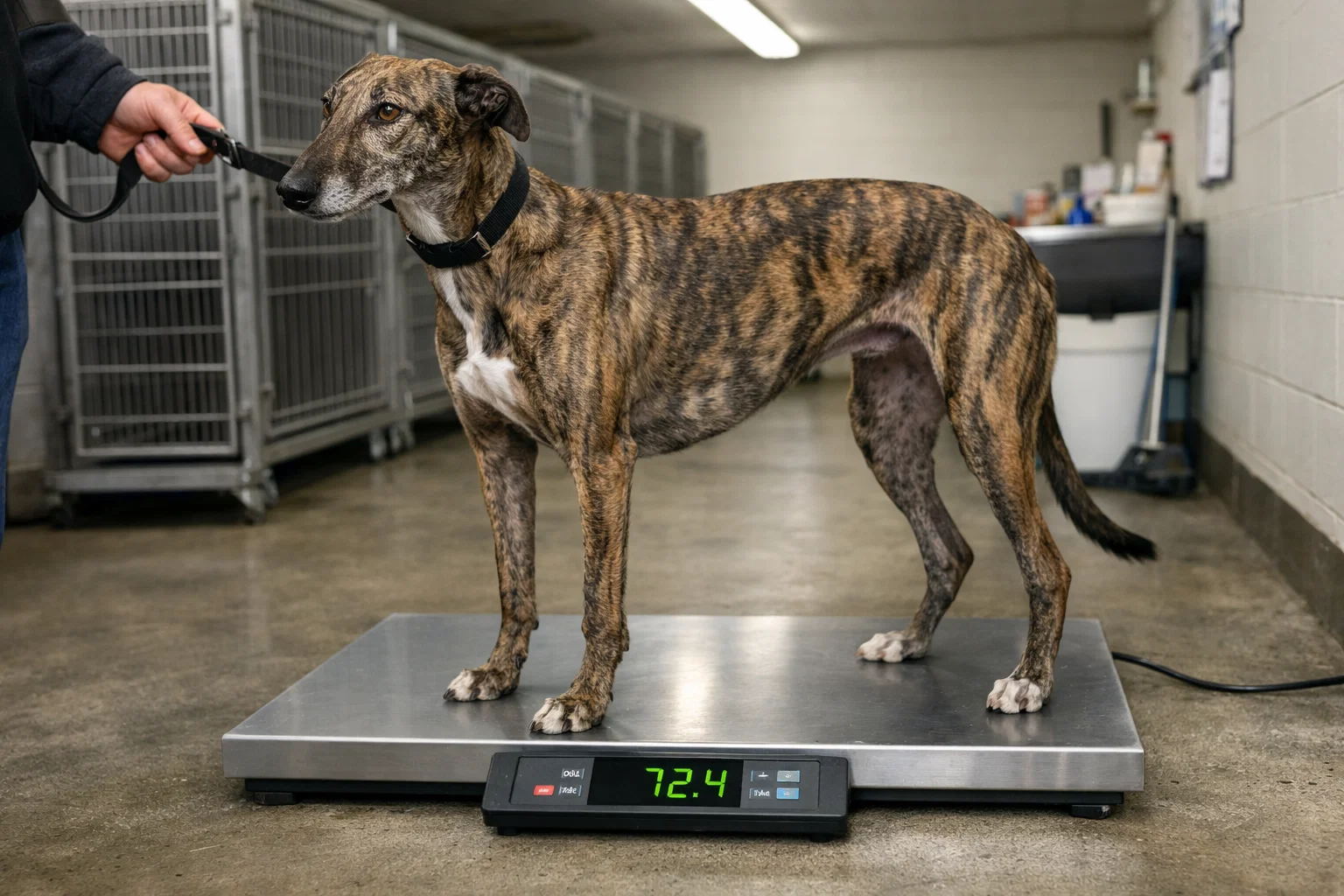
Weight is the form variable that most punters glance at and few interrogate. I used to be in the same camp until I started tracking weight fluctuations for every dog in my Harlow form database and noticed something that changed my approach: dogs whose weight drifted more than half a kilogram between consecutive racecards underperformed their form figures far more often than the overall average. That finding – crude, based on my own data, and not published in any official report – convinced me that weight is not noise. It is a signal, and learning to read it gives you an edge that the racecard alone does not provide.
See also: harlow greyhound results — your complete Harlow greyhound resource.
Typical Weight Fluctuation in Racing Greyhounds
A racing greyhound in active training typically weighs between 26 and 36 kilograms, depending on its frame and sex. Males tend toward the upper end; females toward the lower. Within that range, the healthy fluctuation between race days is small – usually less than half a kilogram. The kennelling routine, diet and exercise regime that trainers follow are designed to keep racing weight consistent, because consistency means the dog’s muscles, joints and cardiovascular system are operating under predictable load.
GBGB registered 5,899 new greyhounds in 2023 – down 19% from 2019 – and each of those dogs entered the racing system with a baseline weight established during their initial trials and early graded races. That baseline becomes the reference point for all subsequent weight analysis. A dog that trialled at 32.0 kg and races at 32.2 kg is within normal range. The same dog racing at 33.0 kg – a full kilogram above baseline – is carrying meaningful extra weight that warrants investigation.
Day-to-day fluctuations are influenced by hydration, meal timing, stress and kennelling environment. A dog weighed in the morning might be marginally lighter than the same dog weighed in the afternoon after its main meal. These micro-fluctuations are captured in the racecard weight and can produce apparent shifts of 0.1-0.2 kg between consecutive runs that are physiological noise rather than meaningful change. The threshold I use for analytical attention is 0.3 kg or more between consecutive racecards – anything below that I treat as background variation.
When a Weight Shift Matters
A weight gain of 0.5 kg or more in a racing greyhound that is not growing (most racing dogs are fully mature) has three common causes: reduced training volume, dietary change, or a physical issue that is limiting activity. The first two are benign – a trainer might ease off training between meetings to rest the dog, or adjust its diet to address a minor digestive issue. The third is a warning sign: a dog that gains weight because it is not running freely in exercise might be carrying a low-grade injury that has not been officially recorded.
Weight loss is a sharper signal. A drop of 0.5 kg or more in a mature racing greyhound usually indicates one of two things: the trainer is deliberately trimming the dog to improve performance over a specific distance (particularly for sprint or stayer races where power-to-weight ratio matters), or the dog is not eating normally, which can indicate stress, illness or discomfort. Deliberate weight management is positive and often precedes an improved performance. Involuntary weight loss is negative and often accompanies a run of poor form.
The direction and consistency of weight changes matter more than any single reading. A dog that has gained 0.3 kg in each of its last three runs – a cumulative gain of nearly a kilogram – is on an upward trajectory that needs explanation. A dog whose weight has been stable across six consecutive racecards and then drops 0.5 kg in one outing has experienced a sudden change that demands attention. Trends tell stories; individual readings often do not.
I also look at weight in the context of performance. A dog that gained 0.3 kg and improved its calculated time is carrying the extra weight comfortably. A dog that gained 0.3 kg and ran two spots slower is being burdened by it. The weight-performance relationship is not linear – a small gain does not automatically mean a slower time – but when the two signals align (weight up, time up), the conclusion is clear: the dog is less fit than its previous run and should be downgraded in selections.
Weight Patterns at Harlow Meetings
Harlow’s schedule of six-plus meetings per week means some dogs race frequently – every four to five days – and their weight on the racecard reflects a closely monitored training regime. High-frequency runners at Harlow tend to show tighter weight stability than dogs that race once a week or less, because the constant racing keeps their routine locked in. A dog that races every Monday and Friday at Harlow will often show weights that vary by less than 0.2 kg across ten consecutive racecards. That consistency is itself informative: if the weight suddenly jumps outside the established band, something has changed in the dog’s routine or health.
Read our Harlow greyhound form guide.
Seasonal patterns also show up in Harlow weight data. Dogs tend to carry slightly more weight in winter – typically 0.2-0.4 kg above their summer baseline – because reduced daylight and colder kennelling conditions affect metabolism and activity levels. This seasonal variation is normal and does not indicate a problem, but it means you should compare a dog’s current weight to its recent form-line weight rather than to a summer baseline from six months ago. Seasonal adjustment is a small analytical refinement, but in a form book where margins are measured in hundredths of a second, small refinements accumulate.
The favourite at Harlow wins approximately 36% of graded races, and within that cohort, weight-stable favourites outperform weight-fluctuating ones. I tracked this split across a twelve-month sample: favourites whose weight had changed by less than 0.3 kg from their previous run won at around 39%, while those whose weight had shifted by 0.5 kg or more won at closer to 30%. The sample is not large enough to be definitive, but the direction is consistent with the hypothesis that weight stability correlates with racing readiness.
For practical purposes, I add weight data to my racecard notes as a three-run trend: stable, gaining or losing, with the magnitude noted. A “stable” dog gets no adjustment. A “gaining” dog gets a minor downgrade. A “losing” dog gets a flag for further investigation – is the loss deliberate (positive) or involuntary (negative)? This three-category system takes about ten seconds per dog and adds a layer of insight that most punters skip entirely.
